
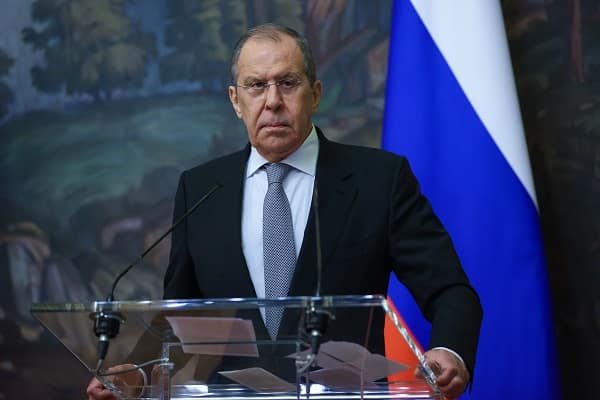
Sergei Lavrov has warned that a war between Russia and Europe would be “short”, escalating Moscow’s rhetoric towards European governments as Germany moves to strengthen its military posture and support for Ukraine.
The Russian foreign minister told reporters at the United Nations General Assembly in New York that Moscow had no intention of going to war with Europe, while accusing European leaders of preparing for an armed conflict with Russia.
“We have no intention to fight Europe, to engage in warfare with Europe – that is utter nonsense,” Lavrov said.
“But Europe is preparing for war with us. They constantly reiterate that, by 2030 at the latest, we, the Europeans, must be ready for war.”
Read more related news:
Streeting warns Britain faces unprecedented risk of war with Russia
British bosses given secret Whitehall briefings on Russian attacks
Defence Secretary tells Brits to prepare for ‘war’ and buy water and food
Evacuation plans drawn up for NATO corridor exposed to Russian attack
Lavrov argued that increased European defence spending could itself create a greater risk of conflict.
“You know, this could turn into a self-fulfilling prophecy, because they are currently investing huge amounts of money in the production of weapons,” he said.
He suggested that political leaders could eventually decide to use the military capabilities being accumulated.
“And at some point, some adventurer, and there are many of them in these elites, will say, ‘Guys, we’ve accumulated so much, what do we do with it?… Oh, we promised to attack Russia.’”
“If they attack us,” he added, “we are not going to… stand idly by.”
Lavrov then issued his most stark warning, in an apparent reference to the potential escalation of a conflict involving nuclear weapons.
“It will be a completely different war, and it will be short,” he said.
The remarks came only hours after Lavrov held talks with Germany’s foreign minister Johann Wadephul on the sidelines of the UN General Assembly. It was the first face-to-face meeting between the two countries’ foreign ministers since before Russia’s full-scale invasion of Ukraine in 2022.
The encounter underlined the increasingly difficult relationship between Moscow and Berlin. Lavrov subsequently accused Germany of seeking to create a “Fourth Reich” and criticised what he described as the resurgence of “Nazism” in Europe.
“This trend in Europe is evident not only in its open support for Nazism in Ukraine,” Lavrov said.
He also criticised German Chancellor Friedrich Merz for saying Germany should once again become Europe’s leading military power.
“Does he understand the meaning of ‘once again’?” Lavrov asked, invoking Germany’s role in the second world war.
Wadephul subsequently briefed European allies on his meeting with Lavrov. According to a message reported from the German foreign minister, he used the encounter to reiterate Berlin’s position on Russia’s war against Ukraine and press for an immediate and complete ceasefire.
He also highlighted grain exports and energy infrastructure as immediate priorities.
Relations between Moscow and Berlin have deteriorated further following German allegations that Russia was behind an attempted drone attack on Leipzig/Halle Airport in August.
German Interior Minister Alexander Dobrindt said an assessment of the drone technology and other intelligence had led the government to conclude that Russia was responsible for what Berlin described as a hybrid attack.
“We do not view the Leipzig incident in isolation, but rather see it in the context of other hybrid actions,” Dobrindt said.
“We assume that Germany is the target of further hybrid attacks by Russia.”
Berlin has since announced measures including the closure of Russia’s consulate in Bonn, the cancellation of the contract for the Russian House cultural centre in Berlin and tighter entry controls for Russian nationals.
Wadephul has also said Germany will propose additional Russian individuals for EU sanctions, while Russia’s ambassador Sergei Nechayev has been summoned by the German government.


Leave a Comment