
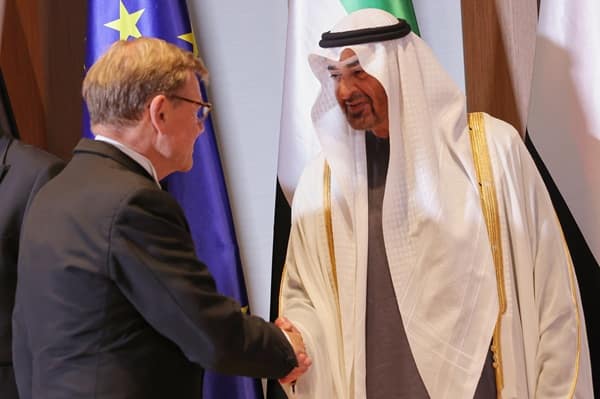
As UAE President Sheikh Mohamed bin Zayed Al Nahyan meets Germany’s leaders in Berlin, the two economies are moving towards a more ambitious model of partnership — one built around investment, technology, industrial capacity and access to new markets.
The ceremonial side of President Sheikh Mohamed bin Zayed Al Nahyan’s state visit to Germany has been unmistakable. After arriving in Berlin, the UAE leader was received with military honours before holding talks with German President Frank-Walter Steinmeier at the historic Villa Borsig. He is also meeting Chancellor Friedrich Merz as the two governments look to deepen a relationship that has been developing for more than five decades.
Behind the ceremony befitting such an important state visit is a critical economic question: what should the next generation of German-Emirati relations actually look like?
For decades, the economic relationship between Germany and the United Arab Emirates largely followed a familiar pattern. Germany exported machinery, cars and industrial expertise. The Gulf supplied energy and, increasingly, investment capital.
That model has long served both countries well, but no longer captures the full scale of the opportunity for greater cooperation and economic prosperity for both.
The state visit is expected to produce multi-billion-euro agreements spanning industries such as technology, artificial intelligence and energy. UAE Minister of State Her Excellency Lana Nusseibeh described the ambition ahead of the visit as moving beyond reaffirming an existing relationship towards building its next chapter.
The two countries already have a substantial economic relationship: bilateral trade exceeded $15.5 billion in 2025, while roughly 2,000 German companies operate in the UAE, with significant German groups ranging from BMW and Siemens to ThyssenKrupp and Deutsche Bahn having established a presence there.
This already-strong economic relationship is likely to be reinforced in the coming years.
Germany remains one of the world’s most sophisticated industrial economies, with deep capabilities in engineering, manufacturing, chemicals and applied technology. The UAE brings a complementary set of advantages: long-term capital, energy expertise, rapidly developing digital infrastructure and strong commercial links across the world, particularly in the Middle East, Africa and Asia.
That critical combination matters greatly at a time when industrial competitiveness requires enormous investment. Artificial intelligence, advanced manufacturing, robotics, energy storage and industrial decarbonisation are all capital-intensive. They also depend on something that cannot simply be purchased: the ability to turn technology into manufacturing processes that work reliably at scale.
This is where German and Emirati ambitions increasingly overlap. Germany’s ambassador to the UAE, Tobias Tunkel, has pointed to significant untapped potential in combining the Emirates’ growing expertise in artificial intelligence with Germany’s manufacturing base, particularly in areas such as AI-enabled robotics.
Faisal Al Bannai, Adviser to the UAE President for Strategic Research and Advanced Technology, made a similar case ahead of the visit: “Germany has significant strengths, such as a strong base of industry, engineers, and talent. The UAE is not afraid to champion new ideas and concepts and truly act as a pioneer. I think that by combining our complementary strengths, we can achieve more together than either side could on its own.”
The timing is quite important too.
Germany is reassessing the dependencies on which parts of its economic model were built. Russia’s invasion of Ukraine forced a rapid diversification of energy supplies. Competition over artificial intelligence, advanced manufacturing and critical technologies has intensified around the world. Supply-chain resilience and access to reliable international partners are no longer peripheral business concerns; they are increasingly part of industrial strategy.
Chancellor Merz made that argument explicitly during his visit to Abu Dhabi in February, saying that Germany needed such partnerships “more than ever at a time when major powers are increasingly dominating politics”.
The relationship also has a wider European dimension. Germany supports negotiations towards a European Union free trade agreement with the UAE, potentially giving the bilateral relationship greater relevance to Europe’s broader effort to diversify its commercial and strategic partnerships.
In Berlin, Sheikh Mohamed and Steinmeier discussed a number of the key regional and international developments, including efforts towards lasting peace in the Middle East and greater regional stability, underscoring how the two countries’ strong economic partnership does not exist in isolation from a much less predictable geopolitical environment.
At such a time, more than ever both countries stand to benefit significantly from their deepening partnership. If Germany and the UAE can turn the current political momentum and investments into a durable, deep industrial partnership in which German technology and manufacturing expertise are skilfully combined with Emirati capital, infrastructure and international reach, the UAE may become much more than one of Germany’s most important trading partners in the Gulf. It could become one of the core partners shaping the next phase of German industry.


Leave a Comment