
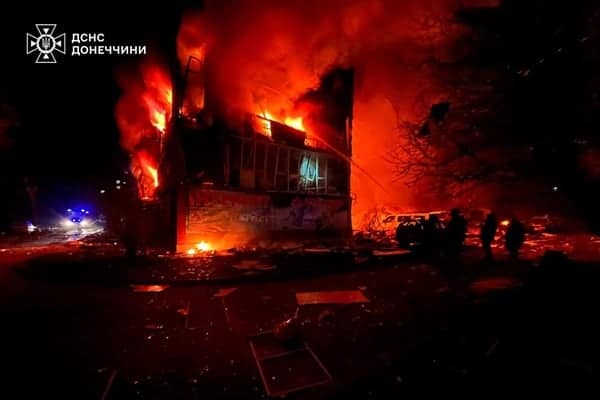
For nearly four years, Russia has attempted to present its invasion of Ukraine as an unstoppable force, a slow, grinding inevitability driven by size, manpower, and brute force. That narrative no longer holds.
The war has entered a new phase, one defined not by Russian momentum but by Ukrainian initiative. I say new, but those of us in Ukraine have seen this shift for some time.
The difference is that it has not been fully reflected in Western media reporting. Ukraine is now launching drones and ballistic strikes into Russia almost daily.
Russian military infrastructure, energy facilities, logistics hubs, and ports are routinely hit, and this week, Ukraine crossed another psychological and operational threshold: the reported disabling of a Russian Kilo-class submarine in Novorossiysk.
Whether Moscow chooses to admit it or not, the strategic balance has shifted.
https://t.co/0xfIdK4Kpe
🚨OMG – The SBU hit a Russian submarine in NovorossiyskThe Security Service of Ukraine carried out another unique special operation and staged a naval "showdown" in the port of Novorossiysk. For the first time in history, underwater drones "Sub Sea Baby"… pic.twitter.com/m4W3huxawT
— Shaun Pinner (@olddog100ua) December 15, 2025
This is no longer a war in which Ukraine merely reacts. It is shaping the battlespace, inside Russia itself. Not bad for a country with “no cards.”
From “three days” to strategic failure
When Vladimir Putin launched the full-scale invasion in February 2022, the objectives were clear, publicly stated, and widely broadcast. Kyiv was to fall. Ukraine was to be “demilitarised” and “denazified.” The government would be replaced or neutralised. NATO influence would be rolled back. Ukraine would cease to exist as an independent strategic actor.
Read more related news:
Ukraine destroys a $500 million Russian kilo-class submarine
Ukrainians reject war time elections and 75% oppose giving Putin territory
The unarmed line of defence: Ukraine’s Home Guard under fire
None of those objectives have been achieved.
Kyiv did not fall. The Ukrainian state did not collapse. The Ukrainian military did not disintegrate. Instead, it hardened, adapted, and evolved under fire.
Russia’s failure in the opening months forced the war into one of attrition, a form of warfare Russia understands historically, but which in modern conditions comes at a devastating cost. That cost has now reached a scale that undermines Russia’s long-term ability to impose its will.
Innovation as a weapon
Ukraine’s greatest advantage has never been numbers. It has been adaptability.
While Russia relied on mass mobilisation, coercion, and inherited Soviet doctrine, Ukraine built a war-fighting culture based on speed, decentralisation, and innovation. Nowhere is this clearer than in the use of drones.
What began as ad-hoc commercial quadcopters in 2022 has become a layered drone ecosystem: reconnaissance, strike, loitering munitions, electronic warfare platforms, long-range UAVs, and maritime systems. Drones now dominate the tactical battlefield, shape operational planning, and increasingly drive strategic effects far from the front line.
Russian armour no longer manoeuvres freely. Supply routes are constantly monitored. Artillery positions are exposed within minutes. Crucially, the war no longer stops at the border.
More strikingly, drones once reserved for high-value targets are now used to strike individual soldiers with immense precision, flown through slits in fortified positions more effectively than any artillery system. UAVs are also being used for resupply and casualty evacuation, reshaping battlefield logistics at the lowest tactical level.
The end of Russian “sanctuary”
For much of the war, Russia relied on depth, geography, distance, and scale, as protection. The West consistently over-evaluated Russian capabilities, and Russia did the same. That illusion has collapsed.
Ukraine is now striking oil depots, refineries, airfields, ammunition stores, and logistics hubs deep inside Russia. Ballistic strikes and long-range drones have forced Moscow to disperse assets, strengthen air defences across vast territory, and accept that the war has come home.
This week’s reported strike on a Russian submarine in Novorossiysk is emblematic of that shift. The Black Sea Fleet, already forced to retreat from Sevastopol, now faces threats in ports once considered secure. Submarines designed to launch cruise missiles at Ukrainian cities are themselves becoming targets. Being beaten by a country without a conventional Navy.
A modern day Navy.
The message is clear: there are no safe rear areas anymore.
A wartime economy under pressure
Russia has placed its economy on a permanent wartime footing. That decision has consequences, big consequences, and you do not need to be an economist to see their effects.
A militarised economy depends on energy exports, industrial throughput, and logistics continuity. Ukraine’s strike campaign increasingly targets precisely those systems, not to cause immediate collapse, but to create cumulative stress.
Each refinery strike increases insurance costs. Each disrupted terminal complicates exports. Each damaged rail hub or depot forces rerouting and delays. This is not symbolic warfare; it is economic attrition.
Russia can continue fighting, but it is doing so at growing financial, industrial, and political cost. When roughly 40 per cent of the federal budget relies on oil and gas exports, those pressures show up quickly on the balance sheet.
Casualties without strategic gain
The human cost of Russia’s approach is staggering.
Western defence estimates now place total Russian casualties, killed and wounded, at over one million since 2022. These losses have not delivered decisive results. Instead, they have hollowed out professional units, forced repeated mobilisation waves, and degraded overall force quality.
And what has Russia gained in return?
Since the major Ukrainian counter-offensives of 2022, Russia has taken under 2 per cent of Ukraine’s territory. Years of fighting, hundreds of thousands of casualties, and enormous economic strain have produced marginal, localised gains measured in kilometres, not outcomes.
This is not victory. It is strategic stagnation, and it explains why Russian propaganda around places like Kupiansk and Pokrovsk has become so frantic. The narrative needs success because the reality does not provide it.
Putin’s war aims and why they failed
Putin’s original justifications for the invasion were explicit. They can now be measured against reality.
- “Demilitarisation” of Ukraine: Ukraine today fields a larger, more experienced, and more technologically advanced force than in 2022.
- “Denazification”: A propaganda construct that never reflected reality and convinced no serious external audience.
- Preventing NATO influence: Russia has driven Ukraine closer to Western military integration than ever before.
- Protecting Russian speakers: Russian-speaking cities have been destroyed by Russian firepower.
- No intention to occupy Ukraine: Russia has entrenched itself in occupied territories while failing to expand control meaningfully.
Every stated objective has either failed outright or produced the opposite result.
The real power shift
The decisive shift in this war is not a single strike, weapon, or announcement. It is structural.
Ukraine now chooses when and where to apply pressure. It disrupts Russian logistics, forces defensive overreach, and degrades high-value assets with comparatively low-cost systems. It has turned innovation into a strategic weapon.
Russia, meanwhile, is trapped in a model of warfare that trades lives for metres and hopes time will compensate for adaptation. Time, however, is now working against it.
A submarine allegedly disabled in Novorossiysk is not just a tactical event. It is a symbol of a broader reality: Russia’s depth is shrinking, its assumptions are collapsing, and Ukraine has seized the initiative.
This war did not end quickly. It has become something else entirely.
And in that transformation, the balance of power has moved decisively, and irreversibly, away from Moscow.


Leave a Comment