
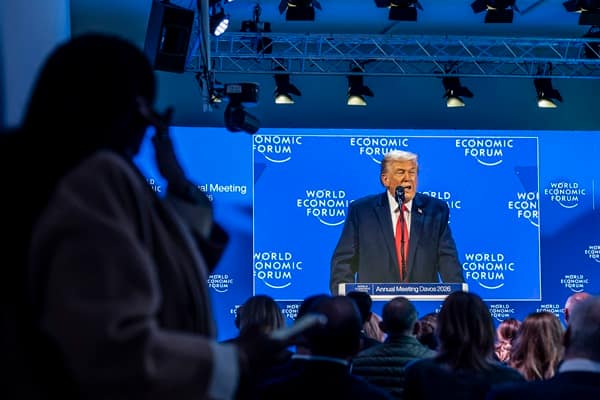
Donald Trump’s appearance in Davos this week was supposed to reassure. Instead, it exposed a reality that Europe has been slowly and reluctantly confronting since Russia’s full-scale invasion of Ukraine: the United States, under its current leadership, can no longer be treated as a predictable or reliable security partner.
The speech itself was chaotic even by Trumpian standards. In one breath, Trump appeared to suggest that NATO might not come to America’s aid; in the next, he launched into a bizarre tirade about wind power.
He repeatedly referred to Greenland as Iceland and, at one point, attempted to lecture a Davos audience by claiming that “if it wasn’t for America, you’d all be speaking German”, an extraordinary remark to make in Switzerland, where German is already one of the country’s primary languages.
These moments were not merely embarrassing gaffes. They were symptoms of something far more serious: a worldview that reduces alliances, shared sacrifice, and institutional stability to transactional theatrics.
Davos, a forum built on economic confidence and international cooperation, instead received a reminder that volatility now sits at the very top of American power.
The Greenland episode is particularly revealing. Framed once again as a “security concern,” Trump’s fixation with the territory echoed his earlier attempts to purchase it outright, an approach that blurred the line between geopolitical strategy and imperial impulse.
CNN reported that a key group of European Parliament members blocked a vote to ratify a long-anticipated U.S.–EU trade deal indefinitely following Trump’s Greenland and tariff threats, underlining that Brussels is not prepared to bend simply because Washington demands it. The irony is striking: while claiming to protect the West from Russian or Chinese encroachment, Trump simultaneously undermines NATO, alienates allies, and weakens the very deterrence architecture that has kept Europe secure for decades.
And yet, amid the noise, one uncomfortable truth has become unavoidable, and on this narrow point, Trump may be right. Europe can no longer rely on America in the way it once did.
That statement should not be read as defeatist, nor should it be framed as anti-American. It is simply a recognition of reality. Vladimir Putin’s invasion of Ukraine shattered the post-Cold War assumption that peace on the continent was permanent. Trump’s behaviour has now shattered the assumption that the United States will always act as Europe’s security backstop, regardless of who occupies the White House.
This does not mean NATO is obsolete. In fact, it means the opposite, NATO was never designed to be a one-way guarantee underwritten solely by Washington. It was meant to be a collective defence alliance, one in which Europe carried real weight, capable and responsible. For too long, that balance was allowed to drift and Ukrainian’s have shown what European resolve looks like when survival is at stake, from military production & innovation to intelligence coordination and energy resilience, Europe has already begun the long process of relearning strategic autonomy, slowly, yes, but it is forming. That is not a retreat from the transatlantic alliance, it is an overdue correction within it and that’s a good thing with Ukraine now leading the way, another failure for Putin.
Trump, for his part, appeared oddly satisfied yesterday, despite obtaining very little that he did not already possess. There were no major concessions, no new commitments, and no meaningful diplomatic breakthroughs. We may yet see more unfold, but for now, the performance appeared to be the point.
That may work politically for him in the short term, but the damage is already done.
For veterans like myself, the speech landed as more than reckless rhetoric. It felt like a slap in the face. After 9/11, it was European allies who stood shoulder to shoulder with the United States — in Afghanistan, in intelligence cooperation, and in blood and sacrifice. That history appears to have been forgotten by a leader who now treats alliances as bad business deals rather than shared commitments forged in war.
So where does this leave us?
Trump’s apparent U-turns, whether on Greenland, NATO rhetoric, or potentially unresolved issues such as the Chagos Islands, cannot undo the strategic uncertainty he has injected into global politics. Allies cannot build long-term security planning on the hope that the next reversal sticks, or that he does not flip again a month or two down the line. Under those conditions, how can anyone seriously rely on security guarantees?
Europe’s path forward is clear, even if it is uncomfortable. Invest in defence, coordinate industrial capacity and strengthen internal resilience while supporting Ukraine as a priority, as outlined by NATO Secretary-General Mark Rutte — not as a burden, but as a frontline partner defending the rules-based order Europe depends on.
As for Trump, he would do far better to turn his attention inward. The United States faces profound domestic challenges, infrastructure decay, political polarisation, veteran care, and economic inequality, none of which are solved by threatening allies or recycling historical myths on the world stage.
Leadership is not about reminding others who once saved whom, but it is about recognising shared responsibility in a dangerous present.
Davos did not reveal a strong America leading the free world in my view. It revealed a world adjusting, finally, to the possibility that it must sometimes lead itself.


Leave a Comment