
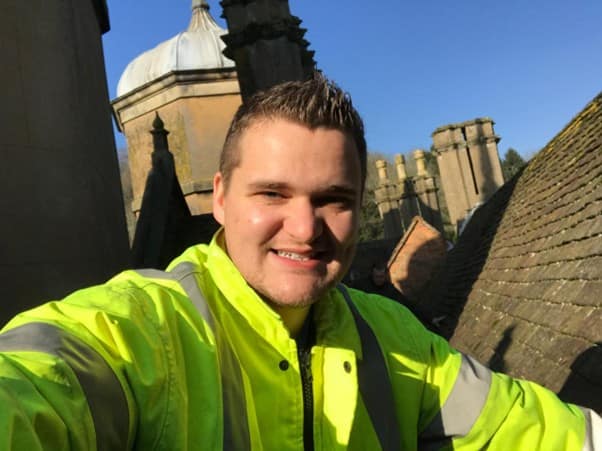
Samuel Leeds lost £3.5 million on Ribbesford House Estate. He also restored a piece of British wartime history, passed it to someone with the vision to finish the job, and says he would do it all again.
When Samuel Leeds purchased Ribbesford House Estate near Bewdley, Worcestershire, he knew he was buying more than a building.
The Grade II* listed country house, which dates back centuries and has its own Wikipedia page, served a remarkable role during the Second World War. Charles de Gaulle visited multiple times. Winston Churchill walked its grounds. And approximately 200 Free French soldiers, men who had escaped occupied France to continue fighting alongside the Allies, trained there during the war. Most of them never came home.
Leeds was not fully aware of the weight of that history when he bought the estate at auction for £810,000. He learned it shortly afterwards, in a way he has never forgotten.
“There was one Free French soldier still alive when I bought the building,” Leeds said. “He flew down to Mayfair and took me out for dinner. Just to say thank you for buying it and for restoring it.”
That dinner, he says, reframed everything that followed, including the losses.
A building on the brink
When Leeds acquired Ribbesford House, it was in a severe state of disrepair. Structurally compromised, exposed to the elements, and at genuine risk of irreversible deterioration, the building needed urgent intervention before any long-term vision could even be considered.
Leeds committed. Over the years that followed, he invested approximately £3 million in structural restoration, making the building weathertight, installing a new roof, and carrying out the major reinforcement work required to stabilise it. All of it was funded from his own cash.
“When I first bought it, the building was completely dilapidated,” he said. “My focus was to stabilise it and save it. We made the structure airtight, put a proper roof on it, and carried out the restoration work to bring it back from the brink. I am genuinely proud of what we achieved.”
The work attracted significant attention. Leeds promoted the project across his social media platforms, which reach hundreds of thousands of followers, generating serious interest from developers and heritage specialists across the country.
Knowing when to pass the baton
As the structural work was completed, Leeds reached a decision point. Planning constraints made his original vision for the site unworkable. And the economics of a full interior restoration, on a listed building of this complexity, were unlikely to stack up in any conventional investment sense.
Rather than push forward regardless or simply sell to the highest bidder, Leeds chose a different path.
“It was not about squeezing out the very last pound,” he said. “What mattered more was that it went to the right person, someone who would continue looking after it properly.”
The estate attracted serious interest. Over 60 buyers registered to bid, and when the process concluded, six of them had made higher financial offers than the one Leeds accepted.
He turned them all down.
Nirad Solanki, Group Chairman of Solanki Holdings Group of Companies, specialises in restoring English Heritage-listed buildings. His vision for Ribbesford luxury residential accommodation within the main house and community-focused use across the wider estate was what ultimately won the building.
The auctioneer handling the sale, Sam Fongho of Midas Property Auctions, described the process publicly as unlike anything he had previously overseen. Where most sales come down to the highest bid, Leeds had made clear that vision mattered more than price.
Fongho noted that Solanki had spent most of an entire day while Fongho was attending MIPIM in Cannes on calls being assessed by Leeds’ team. It felt, Fongho said, less like a property transaction and more like a job interview.
Leeds passed on six higher offers to make it happen.
“I could see that he had the appetite and the expertise,” Leeds said. “This building deserved someone with a real heart for it. Nirad has that.”
Solanki has since described the acquisition as a defining moment for his business, noting publicly that he fell in love with Ribbesford the moment he walked the grounds.
Leeds, meanwhile, posted a simple message on LinkedIn: “It went to the right people. We spent a lot of time and effort on this building and wanted to see it in the right hands. Anything you need, anytime, it’s my honour to help.”
The numbers and what they don’t tell you
On paper, the figures are stark. Leeds bought Ribbesford for £810,000, spent around £3 million restoring it, and sold it for £450,000. The headline loss is approximately £3.5 million.
He is not hiding from that number.
“It still hurts,” he said. “Losing money always does. But anyone who tells you every deal they do is a success is either lying or they haven’t been in the game very long.”
What the headline figure does not capture is the condition of the building when Leeds acquired it versus when he sold it, a structure that was deteriorating rapidly is now weathertight, structurally sound, and in the hands of a specialist with the skills and passion to complete its restoration.
Nor does it capture the fact that Leeds, who anticipated the project carried significant risk from the outset, had structured his involvement accordingly. The estate sat within his trading company, meaning the loss could be offset against profits elsewhere in the business, reducing the real financial impact considerably.
“Experienced investors understand that one deal does not define you,” Leeds said. “You take calculated risks. You win some and you lose some. Then you move on to the next opportunity.”
A legacy worth more than the loss
What stays with Leeds most is not the financial outcome. It is the dinner in Mayfair with the last surviving Free French soldier.
“That man flew to London to thank me for what we’d done with a building where his friends had trained before going off to fight and die,” Leeds said. “You can’t put a number on that.”
Ribbesford House Estate now enters what its new owners call its next chapter, a restoration led by people with the specialist knowledge and genuine passion for heritage that the building has long deserved. The structural foundations for that work were laid, at considerable personal cost, by Samuel Leeds.
“I stabilised it. I saved it. And then I handed it to someone who could finish the job,” he said. “That’s something I’m proud of regardless of what it cost.”
Samuel Leeds is the founder of the Samuel Leeds Academy and Samuel Leeds Finance. He holds property across the United Kingdom, the UAE, Africa, and the United States.




Leave a Comment