
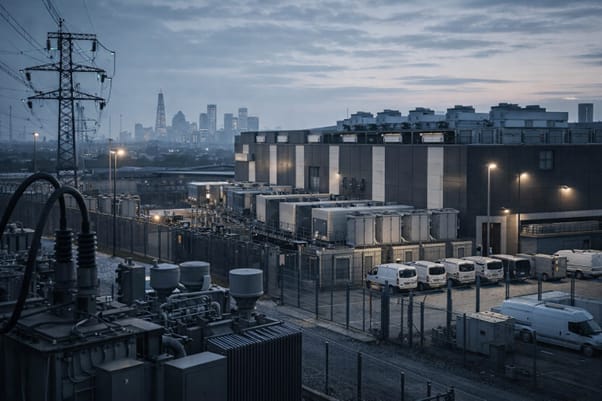
London’s data centre market is growing fast as demand rises from AI, cloud services and an increasingly digital economy. But for businesses operating in the capital, that expansion is creating a different kind of pressure: securing access to the infrastructure they need before capacity, power and space become harder to obtain.
London’s data centre boom is real, but so is the strain behind it
London has become one of the UK’s most important data centre markets, and the pace of expansion reflects how central digital infrastructure has become to modern business. As more organisations depend on cloud platforms, real-time systems and data-intensive operations, investment has continued to flow into the sector.
The capital remains attractive for obvious reasons. It offers dense connectivity, proximity to customers and a commercial environment where low latency and resilience matter. But rapid growth brings pressure of its own. As demand rises, the issue is no longer simply building more infrastructure; it is whether businesses can secure the right infrastructure when they need it.
Why access is becoming a serious commercial issue
For many businesses, the conversation is shifting from availability to timing.
Infrastructure may exist in the market, but that does not mean it is available in the right place, at the right scale or on the right timeline. Capacity is tightening in key areas. Demand is rising faster than many companies expected. Delays linked to energy supply, planning and wider infrastructure constraints are making the market harder to navigate.
It is no longer just about availability. It is about securing access at the right time.
The hidden constraints many businesses are still underestimating
Part of the problem is that the real constraints often remain invisible until they become urgent.
Power availability is one of the clearest examples. As digital demand rises, so does pressure on the electricity infrastructure needed to support data centre capacity. Space is another concern, particularly in London, where land remains limited and expensive. Competition for suitable capacity adds a further layer of pressure, especially for businesses that need resilient environments close to the capital.
These constraints shape more than location. They influence cost, lead times, scalability and the level of certainty a business can build into future planning.
Why businesses are being forced to think earlier
Carbon Z is a UK-based provider specialising in data centre infrastructure and colocation solutions, supporting businesses in securing reliable and scalable environments for critical systems.
According to Carbon Z, businesses are increasingly needing to plan infrastructure earlier, as demand begins to outpace availability in key locations such as London.
That reflects a broader shift in how companies approach infrastructure decisions. For years, many assumed that if more capacity were needed later, the market would provide it. In a tighter environment, that assumption becomes less reliable. Businesses that wait too long may find that preferred options are no longer available or no longer commercially sensible.
How infrastructure strategy is starting to change
As a result, more organisations are adjusting their infrastructure planning well before pressure becomes critical. Some are securing capacity earlier. Others are reassessing how much they depend on future developments that have not yet come online. The wider shift is towards greater certainty and less reliance on assumptions.
As a result, many organisations are turning to providers such as Carbon Z data centre colocation, allowing them to access existing infrastructure without relying on new developments coming online.
That is a practical response to a constrained market. It reflects the growing value of established infrastructure at a time when future supply cannot always be taken for granted.
Why this matters far beyond IT teams
The commercial impact is becoming harder to ignore. Infrastructure constraints can increase operational risk, limit growth and push costs higher. If reliable capacity is difficult to secure, resilience becomes more expensive. If infrastructure decisions are delayed, the knock-on effect can be felt across continuity planning, service delivery and future expansion.
Carbon Z highlights that infrastructure is becoming a strategic business decision rather than just a technical requirement.
That is the real shift. Businesses are not merely deciding where systems will sit. They are making decisions that affect performance, stability and their ability to grow without disruption.
The business planning will have the advantage
Demand in London is unlikely to ease any time soon. The capital will remain a key market for digital infrastructure, but supply will continue to face pressure from power limits, space constraints and competition for access.
That means proactive planning is likely to become more important, not less. Businesses that assess infrastructure needs earlier and build those decisions into wider commercial planning will be better placed than those assuming capacity will simply be there when required.
London’s growth depends on secure, scalable infrastructure
London’s data centre boom is creating new opportunities, but it is also creating new constraints.
For businesses, the challenge is no longer just growth, but ensuring the infrastructure behind it is secure and scalable. In a market where demand is rising faster than easy access, the organisations that plan early and act strategically will be in a stronger position.



Leave a Comment