
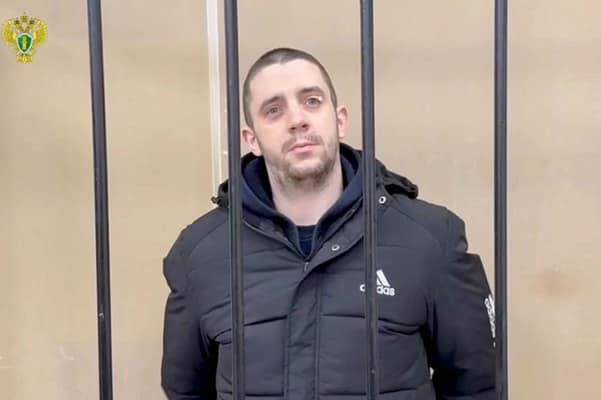
The sentencing of British citizen Hayden Davies to 13 years in a Russian maximum-security prison camp is not merely another grim episode in Russia’s war against Ukraine.
It represents a deliberate and calculated abuse of international law, carried out for propaganda purposes, and one that demands a firm and credible response from the United Kingdom.
Davies, 30, was captured while fighting as part of the International Legion for the Defence of Ukraine, a unit formally integrated into Ukraine’s armed forces.
Despite this, Russian prosecutors have labelled him a “paid mercenary” and tried him in a court operating in Russian-occupied Donetsk, a territory Moscow illegally claimed as its own in 2022, despite Ukraine continuing to control parts of the oblast.
This choice of venue is not incidental. It is central to Russia’s strategy of plausible deniability, allowing Moscow to distance itself from the legal obligations that would apply if Davies were recognised as a Prisoner of War. This is not theoretical. It is a tactic Russia has used before — including in my own case.
Read more related news:
Putin tells Trump ‘to go to hell’ as NATO vows $1bn in weapons for Ukraine
US ‘don’t care about the European position’ and ‘will sell out Ukraine’
Exclusive: Brit Graham Phillips exposed as Putin’s thug wanted for war crimes
Under international humanitarian law, the mercenary designation simply does not apply. Additional Protocol I of the Geneva Conventions sets out a narrow and specific definition of a mercenary, including criteria such as fighting primarily for private gain, lacking membership in the armed forces of a party to the conflict, and having no legal status in the state for which they fight. Davies meets none of these conditions.
He signed a formal contract with Ukraine’s Territorial Defence Forces, a fact acknowledged by the court, wore military uniform, operated within a recognised command structure, and held legal status in Ukraine. By law, he is a lawful combatant and therefore entitled to full Prisoner of War protections.
The circumstances surrounding his conviction only deepen concern. Russian state media released footage of Davies “confessing” while visibly detained, shaven, and standing behind bars. When asked whether he pleaded guilty, he nods and says “yes”. Any legal professional will recognise the problem immediately: statements obtained while in enemy captivity, particularly by a state with a well-documented record of coercion, torture, and forced confessions, cannot be considered reliable evidence. They are not testimony. They are instruments of pressure.
The British government has already acknowledged this reality. Earlier this year, London stated unequivocally that Davies is not a mercenary and is entitled to protection under the Geneva Conventions, while condemning Russia’s exploitation of prisoners of war “for political and propaganda purposes”. That position is legally sound, but it must now be matched by sustained diplomatic pressure and accountability. At present, that response is conspicuously lacking.
Russia’s playbook is by now familiar. Captured foreign fighters are paraded in propaganda videos, criticised for their backgrounds, motivations, or commanders, in an effort to delegitimise Ukraine’s defence and deter international support. These videos are carefully staged, selectively edited, and designed to blur the legal reality of captivity with a political narrative of “mercenaries” and “criminals”.
The trial itself, conducted in an occupied “court” with no international legitimacy, underscores the theatrical nature of the process. This was never about justice. It was about messaging, to domestic audiences, to the West, and to anyone considering standing alongside Ukraine.
What is often missing from this discussion, however, is the broader human cost of this information war. During the filming of my documentary Captured, we travelled across western Ukraine to visit prisoners of war from numerous countries, men from Latin America, Europe, the Caucasus, and beyond, held in Ukrainian POW camps. Many have been forgotten by their home governments, trapped in legal limbo, or quietly abandoned because their cases are politically inconvenient, all while strict adherence to the Geneva Conventions ensured identities were protected and protocols followed.
Their treatment stands in stark contrast to the Russian narrative. These men are held under internationally monitored conditions. They are registered, fed, medically treated, and crucially recognised as prisoners of war under the Geneva Conventions.
Captured (documentary):
The contrast is instructive. Ukraine, despite fighting for its survival, has largely adhered to international humanitarian law. Russia, by contrast, has weaponised the law itself, selectively applying, distorting, or discarding it to serve political ends. The case of Hayden Davies fits squarely within this pattern.
For Britain and the wider West, the implications are serious. If Russia is permitted to arbitrarily redefine lawful combatants as mercenaries, the protections underpinning the laws of armed conflict begin to erode. Today it is Ukraine. Tomorrow, it could be any conflict in which British citizens serve alongside allied forces, whether under UN mandates, coalition operations, or bilateral defence agreements.
Hayden Davies’ imprisonment is a direct challenge to the rules-based international order, and it extends far beyond one man. It affects every foreign passport holder who has chosen to live in Ukraine, to defend it, or who has built a family and a future there. If lawful combatants can be arbitrarily redefined as mercenaries, nationality itself becomes a liability, and the protections of international law become conditional.
The UK, alongside its allies, must respond accordingly. not with statements alone, but with consequences. International law cannot become optional. When it is selectively applied or deliberately distorted, it is not only prisoners who are endangered, but the entire system designed to protect civilians, combatants, and non-combatants alike in times of war.
Yet there is a narrow and important note of hope. Now that Davies has been formally sentenced, he may be eligible for inclusion in future prisoner exchange mechanisms, a process that, however imperfect, remains one of the few pathways to securing the return of unlawfully detained individuals. History shows that even in the darkest moments of this war, exchanges have brought people home, myself included.
Justice in this case may yet come not through the courts of an occupying power, but through sustained international pressure, legal clarity, and coordinated diplomacy. If the rules-based order is to mean anything, it must protect all those who stand within it, regardless of the passport they carry, including those held in Ukraine.


Leave a Comment