
Iran’s war with the United States and Israel has delivered a second stagflation shock to Britain, and this time the pressure point is a narrow stretch of water thousands of miles away.
By weaponising the Strait of Hormuz, Tehran has helped drive energy prices sharply higher, forced the International Monetary Fund to slash its forecasts for UK growth and, now, has pushed the British government into preparing for food shortages at home and relaxing some of its own emissions constraints.
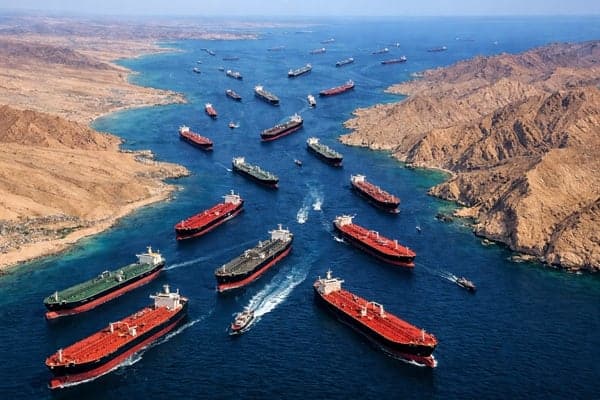
Maritime traffic through the Strait, which normally carries around a fifth of the world’s oil, a significant share of global LNG and key industrial gases, has collapsed as tankers are diverted, delayed or deterred altogether. Insurance premiums for the remaining voyages have surged, naval escorts have become routine, and the risk of further attacks on shipping hangs over every attempt at a ceasefire.
The result has been a classic supply shock to global energy and input markets which have fed straight through into prices paid at the pump, for energy bills – and, increasingly, at the supermarket checkout.
A confidential Briths government exercise, disclosed this week, warns that shortages of carbon dioxide – a crucial by‑product for meat processing, packaging and cold chains – could lead to gaps on shelves for chicken, pork and other chilled goods this summer if the blockage of Hormuz persists. Whitehall has authorised contingency planning under “reasonable worst‑case” assumptions and have already put money into restarting domestic CO₂ production at the Ensus bioethanol plant on Teesside to shore up supplies. Officials stress that they do not expect “critical” shortages, but the fact that Britain is having to model – and publicly acknowledge – food disruption as a direct consequence of Iranian action in the Gulf is striking.
For the UK economy, this comes on top of the energy shock. After the inflationary surge that followed Russia’s invasion of Ukraine, the Bank of England had hoped to steer conditions back towards something like normality. Instead, the IMF now expects growth next year of just 0.8 per cent, down from 1.3 per cent in January, with inflation averaging a little over 3 per cent and, on some measures, heading towards 4 per cent – roughly double the Bank’s target. That combination of weak output and stubbornly high prices has revived a spectre that haunts all finance ministries: stagflation. Households are already feeling the effects through rising fuel and energy costs, firms report that services activity has “slowed to a crawl”, and farmers warn that soaring fertiliser and input prices linked to the Iran conflict are putting food security at risk.
Tehran’s culpability in this is clear. By threatening tanker traffic “to and from” the ports of the US, Israel and their Gulf allies, Iran has deliberately targeted the export lifelines of Saudi Arabia, the UAE, Qatar and Kuwait – the producers whose oil and gas underpin global markets and on whom energy‑importing countries such as Britain ultimately depend. In disrupting that system, it has not only driven up energy and freight costs but also squeezed supplies of industrial gases such as CO₂ that are essential to modern food supply chains. British ministers speak bravely about “diversification” and “resilience”, but as long as global benchmarks are set in a world where Hormuz is effectively held at risk by Iran, they are helpless when it comes to insulating the UK from the economic fallout.
There is now an environmental cost as well. To keep factories running and refrigerators cold, officials have quietly accepted that certain sectors will be allowed to emit more CO₂ in the short term than had been envisaged under pre‑war climate plans, and have committed public money to restarting a domestic CO₂ plant that would otherwise have remained idle.
At the same time, the pressures on the public finances generated by the Iran war have led to cuts in the UK’s climate‑related aid overseas and a broader re‑prioritisation of green spending, prompting warnings from campaigners that the conflict is eroding both Britain’s climate leadership and its emissions trajectory. In other words, a war that began with missile strikes and naval stand‑offs in the Gulf is now contributing, indirectly but measurably, to higher emissions and slower decarbonisation in a country hundreds of miles away.
The IMF’s warning is blunt: of all the advanced economies, Britain will be hardest hit by Iran’s energy attack. What Whitehall’s contingency plan shows is how far that shock now runs – from the price of petrol to the availability of chicken breasts, and from the Treasury’s inflation forecasts to the UK’s ability to keep its climate promises. The common thread is Iran’s decision to weaponise a global choke‑point. As long as the Strait of Hormuz is treated as a lever in Tehran’s struggle with Washington and Israel, Britain will remain on the receiving end of stagflationary forces it did little to create but can do even less to avoid.


Leave a Comment