
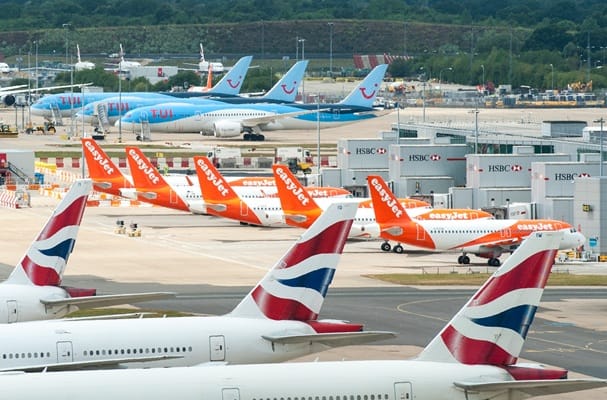
Aviation infrastructure in the U.K. is entering an era of unprecedented growth. The resurgence in commercial air travel has created significant pressures on the country’s airport infrastructure. Runways are always the first point of discussion when expanding an airport; however, there is a significant amount of work being done to improve the operational performance at airports, rather than their physical footprint. This includes hangars, maintenance areas, storage and flexible operational space, which have now become critical to an airport’s ability to expand in a cost-effective manner.
Flexible aviation infrastructure is rapidly gaining acceptance as a viable solution to strategically address the challenges associated with airport expansions. Instead of developing expensive, high-capacity permanent facilities to accommodate anticipated growth, many airport operators are opting for modular and/or relocatable structures that can grow with demand.
Growing demand for airport capacity
UK Civil Aviation Authority (CAA) data indicates that passenger air traffic continues to recover from pandemic-induced disruptions and stabilize. Business aviation has demonstrated its ability to remain resilient, especially at regional airports that serve business and private operators.
These trends present very specific aviation infrastructure needs:
- Additional covered space for aircraft parking.
- Maintenance, Repair and Overhaul (MRO) facilities.
- Airport weather protection zones for ground handlers.
- Aircraft-specific equipment storage.
Due to the time-consuming nature of building permanent structures (planning approval, environmental assessment, financing), airports, which operate under extremely thin profit margins, face severe risks of losing revenue-generating opportunities while waiting for infrastructure to be constructed.
In this context, flexible aviation structures, which can be engineered to meet aviation safety standards and delivered to site more quickly than traditional concrete structures, gain greater relevance. A modern aircraft hangar can be engineered to meet aviation safety standards while offering faster deployment compared to traditional concrete construction. Most flexible aviation structures can be designed to be scalable, allowing airports to add or remove covered area based on operational requirements.
Benefits of modular structures and reduced investment risk
From a business perspective, investing in infrastructure is about balancing long-term asset value with uncertainty around demand. Airline passenger volumes can fluctuate, airlines can change their routes, and geopolitical events can affect the aviation market.
Flexible aviation structures offer several benefits:
1. Lower initial capital expenditures relative to permanent structures
2. Faster construction timelines
3. Potential to relocate or reconfigure structures if airport layouts change
4. Lower long-term risk exposure in unstable traffic environments
For regional airports in particular, the ability to develop infrastructure without locking into multi-decade fixed assets supports their financial resilience.
Engineering companies, such as Spantech, that specialize in designing and building aviation structures provide engineered solutions that meet wind load, snow load and fire safety standards, while providing operational flexibility consistent with industry-wide trends towards modular industrial construction.
Sustainable aviation solutions
Increasingly stringent environmental review processes apply to all types of aviation-related developments. Infrastructure projects must consider issues related to carbon emissions, material usage and land use optimization.
Flexibility-based hangar solutions can assist in meeting sustainability objectives in multiple ways:
- Reduce material usage in comparison to traditional reinforced concrete buildings
- Provide potential for reuse or relocation versus destruction
- Support integration with energy-efficient lighting and insulation systems
- Allow for faster construction timelines reducing the duration of on-site disruption.
By implementing infrastructure on-demand, rather than anticipating future growth through the construction of permanent facilities, airports can better align their expansion of capacity to actual traffic data rather than forecasting assumptions. Avoidance of non-productive permanent structures helps prevent inefficient uses of resources (both financially and environmentally).
Supporting regional economic growth
Airport development and expansion are highly correlated with regional economic growth. Improved airport capacity enables:
- New air routes
- Enhanced cargo logistics
- Increased employment in maintenance and engineering
- More business aviation services
Flexibility in infrastructure design provides smaller airports with the opportunity to compete more effectively. Smaller airports are no longer required to wait for large-scale capital investments in order to implement incremental improvements to their facility base to attract new customers.
In the UK, where regional connectivity is a national priority both politically and economically, we see the incremental model becoming more prevalent. Smaller airports are developing and improving their ground operations to optimize efficiency, rather than focusing solely on headline-grabbing runway expansions.
Agility in modern aviation operations
Modern aviation management values operational agility. Airlines continually modify their fleet size, route frequencies and service offerings in response to changing demand patterns. An airport’s infrastructure should similarly reflect this level of operational responsiveness.
Traditionally built facilities typically constrain airports’ ability to respond to growing demand patterns. Flexible, modular aviation structures enable phased expansion. As fleet size increases, additional bays can be added to existing hangars. Temporary structures can support peak-season demand. Maintenance activities can be scaled up/down without disrupting passenger terminal activity.
This operational agility reduces friction between an airport’s desire to grow and its need to adapt its infrastructure to meet those needs.
Striking the right balance between long-term planning and short-term flexibility
While permanent facilities will undoubtedly continue to dominate major hub airports’ capital investment priorities — primarily in locations where sustained demand exists — we are seeing an emerging paradigm of blending long-term capital investments with flexible, scalable infrastructure.
The resulting hybrid model enables airports to balance their long-term strategic vision with the need to remain agile in responding to short-term fluctuations.
Competitive advantage through infrastructure
Airports are competing for more than simply geographic proximity. They are competing for operational efficiency. Airlines and private operators evaluate airports on their ability to deliver timely turn-around times, available maintenance space and adequate covered aircraft storage prior to establishing an operational presence. Recent academic research also highlights how infrastructure flexibility influences long-term investment resilience. A working paper published via EconStor examines how strategic capacity planning can reduce financial exposure in capital-intensive industries and improve adaptability under uncertain demand conditions. The study, available through the German National Library of Economics repository, underlines the economic rationale behind phased and modular infrastructure development models in sectors such as transport and logistics.
Providing modern, compliant and quickly deployable hangar space increases an airport’s competitive position. The expanding demand for sheltered aircraft storage and service facilities, driven by the evolving nature of business aviation and cargo transport, further emphasizes the importance of flexible infrastructure in supporting these trends.
Therefore, the adoption of flexible aviation infrastructure is not merely a development trend in the construction industry. It represents a fundamental shift in how airports view risk, growth and resilience as they navigate the evolving economic and regulatory landscape in the UK aviation sector. As the UK aviation sector continues to evolve in response to economic and regulatory changes, scalable solutions, such as modular hangars and adaptable operational buildings, are likely to define the parameters of airport expansion strategies.


Leave a Comment