
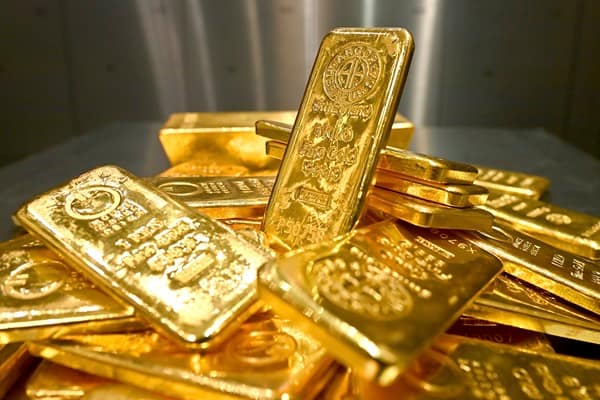
Gold trade in a sideways range slightly below $4400/oz, following quiet trading from the start of the week.
Gold faces a combination of negative factors, driven mainly by the lack of a near-term horizon for settling the Middle East war, along with high escalation risks that fuel waves of bond-yield increase globally.
Added to this is the possibility of renewed extreme liquidity constraints directed toward investments, whether from the region or from Asia.
What is happening in the Middle East now represents a challenge and a test of the hypothesis with which we were framing our short-term expectations regarding the market path, represented by the continuation of the grey situation based on neither war nor peace, which in turn forces sideways paths for prices of commodities directly affected by the war.
The latest wave of escalation began with limited skirmishes, then reached the point of Iran directly targeting US warships, with the latter destroying and sinking Iranian oil tankers that form a lifeline for the Iranian economy, alongside tightening the economic and naval blockade.
The previously discussed grey-zone hypothesis rested, as we noted earlier, on a potential intention by US President Donald Trump to calm this front to lower energy prices before the midterm elections. Meanwhile, the biggest threat to this hypothesis appeared to be the shift in Iranian behaviour from calculated attacks and responses to escalatory strikes, which is what we are seeing today. So far, Iran has not hit US naval vessels. Still, its potential success in doing so in the future, after having been close to it according to US officials who spoke to the Wall Street Journal, could push toward a massive wave of escalation with dire consequences.
It is difficult to predict the intentions of Trump and his administration regarding this campaign, but his taking a risky gamble cannot be ruled out. Trump appears to be betting on confronting this high inflation amid rising gasoline prices that average 4.22 dollars per gallon, and rising diesel prices near their historic record levels at around 6 dollars on average, relying on his promise last night to grant every American citizen 5000 dollars if the Republican Party wins the elections, as well as his pledge to end the war immediately after the elections end. It also appears he is betting on reaching the elections while weakening Iran as much as possible.
If this argument is correct, the continuation of hostilities at the current pace involves major risks of the conflict spiralling out of control and expanding the scope of supply disruptions, through the possibility of targeting export facilities and airspace, whether in Iran or in Gulf countries. Also, the acceleration of escalation on the internal Yemen front and the targeting of Saudi Arabia worsen the risks of supply disruptions. While we will monitor what current clashes lead to, if we return to periods without skirmishes, the grey scenario state might reassert itself, keeping the market stuck in sideways ranges.
This regional disruption, amid the absence of a settlement horizon and the dominance of an escalation climate, would renew liquidity constraints that were expected to flow into gold. This is due to the renewed decline of several Asian currencies, especially in India, making gold more expensive, alongside the likelihood that investors and individuals will prefer cash liquidity in dollar-backed currencies in the Middle East.
On the other hand, gold also receives support from investor concerns, particularly in the money market, about uncertainty over US policy direction. The US Treasury Department’s announcement of accelerating long-term bond buybacks to reach $6 billion was a disappointment, according to the Wall Street Journal. Michael Lorizio of Manulife Investment Management also noted in a statement to the newspaper that questions about the scale of future buyback operations could weigh on the market over the long run, explaining that money markets dislike ambiguity and that such intervention increases it. Policy uncertainty may not only reduce the impact of high yields on gold over time, but also provide an additional incentive for central banks to accelerate their shift away from dollar reserves and toward other currencies and gold.


Leave a Comment