
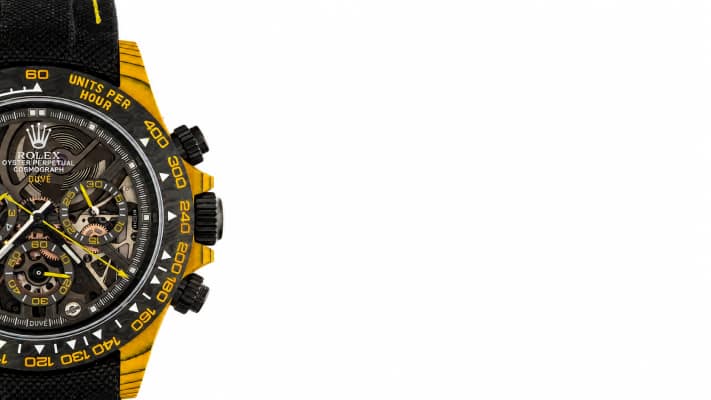
DEK: While traditional luxury assets are treading water, premium watches are holding their ground. Yet the rules behind their rising value are changing in plain sight – and the people who see that change most clearly are not fund analysts, but the craftsmen behind watch customisation.
By the end of 2025, the Knight Frank Luxury Investment Index had fallen by 0.4%, while luxury watches gained 5.1%. Over the past decade, they have risen by around 125% – the second-best result among collectible categories, behind wine. But value is formed differently for serial-production models and for one-of-a-kind pieces.
At DUVE, a workshop specialising in the customisation of premium watches, the shift is described more bluntly than is customary in the market: what collectors regarded as a risk for decades is increasingly seen here as a source of value. That shift explains why such watches are holding up while the rest of the luxury market is declining.
A quiet asset
The resilience of branded, rare and customised watches is not just a matter of fashion. It is also a matter of infrastructure. An entire industry of authentication, certification and transparent condition assessment has grown around the secondary market, making a purchase outside a boutique almost as predictable as a visit to one. This is what turns a consumer item into an asset: an asset needs liquidity, and liquidity depends on trust.
Two names remain the market’s main benchmarks. According to market indices, Rolex prices on the secondary market rose by around 4.6% in 2025, while Patek Philippe gained more than 12%. Rolex acts as a barometer for the whole segment: when its prices stabilise, demand across the rest of the market tends to follow. But behind these two brands lies a more complicated picture, one in which the old pillars of value are no longer as reliable.

DUVÉ
The secondary market has grown up
The scale of the change is easiest to measure in money. The pre-owned luxury-watch market is valued at roughly $32 billion and, according to Grand View Research, could grow to $85 billion by the early 2030s, at an annual rate of around 13%. Deloitte goes further in its industry research, suggesting that the secondary market will grow faster than the primary one and could approach the new-watch market in size over the next decade.
The psychology of the transaction has changed too. Not long ago, “pre-owned” in luxury sounded like a compromise; today, it sounds like a rational choice. According to Deloitte, around seven in ten watch-industry executives believe the secondary market has a positive effect on brand perception. Buyers in this market are also behaving more like investors: they look beyond showroom shine to long-term value retention, authenticity, service history and the provenance of a particular watch.
That last word is crucial. Provenance, rather than gloss, is becoming the currency of the new market.
Rarity no longer guarantees returns
It used to be taken for granted that a limited series, a waiting list, and scarcity would inevitably drive prices up. Today that is no longer enough. A small production run still matters, but on its own it no longer inspires trust.
Buyers have grown more sophisticated. They can now tell genuine uniqueness apart from scarcity manufactured by marketing. What they look at instead is cultural v
alue, ownership history, and the use of rare materials and details that simply cannot be reproduced.
“The market has stopped paying for scarcity and started paying for what can’t be repeated. We see it in the requests we get: more and more, clients don’t want a rare series — they want a piece that will never have a second,” says Evgen Kolotilin, owner of DUVE. Follow that idea to its conclusion, and the highest form of uniqueness turns out to lie not in small series but in a single, one-of-a-kind piece. And this is precisely the territory where customization ateliers operate.
The economics of a one-of-a-kind piece
Customisation has always raised questions among collectors. For vintage and rare serial-production watches, factory originality is often paramount: a poor intervention can reduce the price and strip a piece of its appeal at auction.
But not every modification works in the same way. One custom project can turn a watch into an object with no market; another can create a new, self-contained piece. The difference lies in how carefully the original model is handled, whether the process can be documented, and whether the result matches the standard of the watch itself.
At DUVE, this line is drawn according to several criteria: whether the intervention is reversible and the donor watch is preserved; whether the full process is documented; and, ultimately, whether the level of execution is something the market can recognise and value. In essence, this is not a list of services but a valuation methodology – the same questions an auction house would ask, only asked before the craftsman picks up a tool.

DUVÉ
A full carbon conversion changes both the weight and character of a case: forged carbon is lighter than steel, and no two fibre patterns are alike. Skeletonisation requires handwork on the movement under a microscope. Dials made from meteorite or natural stone are likewise never identical. In such projects, value comes not from modification itself, but from the complexity of the work, the material and the quality of execution.
What can’t the markets measure?
It is with a one-off piece that the market reaches its own limits. Rolex and Patek have indices, quotations and sales histories – enough data to build a portfolio almost as one would with equities. A unique object has neither a ticker nor comparable sales: the market can price a series, but it cannot price uniqueness. The valuation of bespoke watches rests not on statistics, but on expert judgement: the quality of the work, the workshop’s reputation, the reversibility of the intervention and the transparency of the provenance.
That creates a paradox in favour of craftsmanship. The more the market moves away from scarcity and towards irreproducibility, the more of a watch’s value cannot be extracted from data – and the more important the expertise of those who create that irreproducibility becomes. A workshop stops being a service provider attached to a watch and becomes an institution of valuation: it answers a question the market can ask, but cannot answer.
A new formula for value
Luxury buyers are paying less and less simply for scarcity. Value increasingly rests on the fact that an object cannot be replicated: on its history, quality and clear provenance. Indices can still show what is happening to serial-production models. But they cannot answer the central question of the unique-watch market: what is an object worth when it has no equivalent and there will never be another exactly like it?
For DUVE, this is everyday work; judging by the direction of demand, it may soon become a task for the market as a whole.




Leave a Comment