
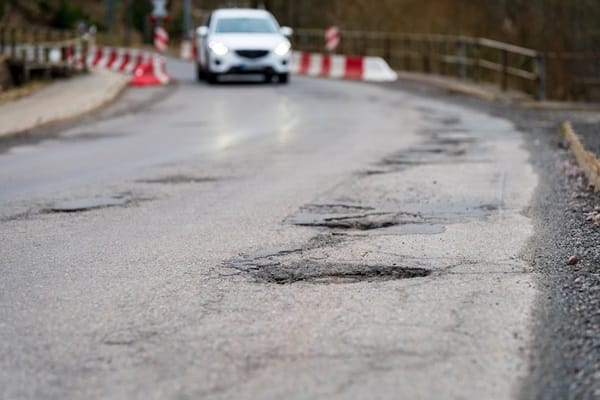
The estimated cost of repairing pothole-ridden roads in England and Wales has risen to a record £18.6 billion, according to a new report that describes the condition of the network as “a national disgrace.”
Research conducted by the Asphalt Industry Alliance (AIA) reveals that only 51 per cent of local roads are currently rated in good condition, despite increased government funding to address the problem.
The AIA’s annual ALARM (Annual Local Authority Road Maintenance) Report indicates that resurfacing work is progressing at an extremely slow pace, with roads being fully resurfaced on average once every 97 years. Over the past year, local authorities filled approximately 1.9 million potholes, yet the overall condition of the road network continues to deteriorate.
David Giles, chair of the Asphalt Industry Alliance, stated that noticeable improvements remain “a long way off.” He added, “I think all road users would agree that the condition of our local roads has become a national disgrace.
Giles said: “While local authority highway engineers told us they are cautiously optimistic that the increased funding will help them stem further decline, it is not the silver bullet that will clear the backlog of repairs any time soon.
“It will be some time before the impact of increased funding levels, if fully delivered, will be noticed by the public.”
For the 2025–26 financial year, government funding for local road maintenance in England is set at nearly £1.6 billion, reflecting a £500 million increase from the previous year. Additionally, ministers have pledged £7.3 billion over the next four years, leading up to the 2029–30 financial year, to tackle this issue. However, Giles suggested that the situation could improve more quickly if the funding were distributed front-loaded rather than gradually increasing toward the end of the decade.
Based on a survey of local authorities, the report estimates that it would take 12 years and £18.6 billion to restore local roads to an ideal condition. Highway maintenance budgets for 2025–26 have increased by 17 per cent to an average of £30.5 million per council, with 54 per cent of spending allocated to road surfaces and structural repairs.
Potholes typically develop when rainwater seeps into cracks in the road surface, then freezes and expands as temperatures fall below zero, widening the cracks and ultimately breaking up the asphalt.
AA president Edmund King warned that “much more needs to be done to eradicate this plague of potholes”.
He added: “We have been seeing with our own eyes, and feeling with our wheels, how record wet weather linked to substandard roads has led to many local roads becoming patchwork obstacle courses.”


Leave a Comment