
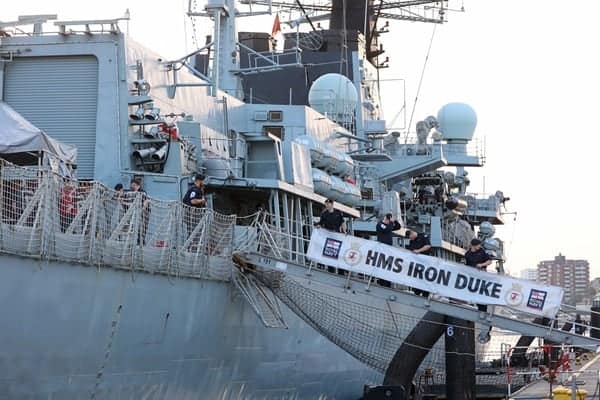
The Royal Navy has been reduced to just five active frigates following the effective withdrawal of HMS Iron Duke, deepening concerns over Britain’s maritime readiness at a time of rising Russian naval activity in the North Atlantic.
The Type 23 frigate, once a mainstay of the fleet and a regular presence shadowing Russian warships in waters close to the UK, has not been to sea since October and has reportedly been stripped of key weapons and sensors.
While no formal decommissioning has been announced, defence sources suggest the ship is unlikely to return to operational service, despite undergoing a £103 million life extension programme completed less than three years ago.
The Ministry of Defence has said any decision on the vessel’s future will be announced “in the usual way”.
The development leaves the Royal Navy with just five operational frigates at a time when senior military figures are warning of increasing pressure on Britain’s maritime defences. It comes only days after the First Sea Lord raised concerns about what he described as an “open sea border” with Russia in the North Atlantic, warning that Russian incursions into UK waters have risen by nearly a third over the past two years.
Read more related news:
US Senator mocks Starmer saying his popularity ranks ‘up there with gonorrhoea’
National service returns to the table as defence chief warns of ‘corrosive complacency’
Reeves accused of risking UK security as she blocks defence spending surge
Former general warns UK military ‘cannot afford’ modern battlefield systems
The remarks have intensified scrutiny of the Government’s defence posture, particularly as Britain’s surface fleet continues to shrink ahead of the arrival of next-generation warships.
The Duke-class Type 23 frigates, including HMS Iron Duke, were originally designed for an 18-year service life but have remained in operation for more than three decades.
They have formed the backbone of the Royal Navy’s anti-submarine warfare capability, routinely tracking Russian vessels moving through the English Channel and wider Atlantic approaches.
However, ageing systems, rising maintenance costs and crew pressures have accelerated their gradual withdrawal from frontline service. HMS Richmond is also due to be decommissioned this year, further compounding the short-term reduction in escort vessels.
A Ministry of Defence spokesperson said: “The Royal Navy keeps planned out-of-service dates under continual review as part of routine force planning, balancing operational requirements and affordability.
“Any decommissioning decisions will be announced in the usual way.
Through the Strategic Defence Review, we are building a new hybrid navy – investing in world-class submarines and cutting-edge warships, transforming our aircraft carriers, and introducing autonomous vessels to patrol the North Atlantic and beyond.”
Defence analysts warn that the gap between the retirement of Type 23 frigates and the introduction of their replacement risks leaving the Navy under-strength during a period of heightened global tension.
The planned successors — the Type 26 and Type 32 frigates — are expected to modernise Britain’s surface fleet significantly, with advanced anti-submarine and multi-role capabilities. But delivery timelines remain uncertain, with only a handful expected to enter service before the end of the decade.
That delay has raised concern within defence circles that the Navy could face a sustained period of reduced operational availability, particularly in the North Atlantic, where Russian submarine and surface activity has increased.
The shrinking frigate force adds to broader concerns about the Royal Navy’s ability to sustain continuous deployments across multiple theatres. Recent months have already seen extended tasking of remaining vessels, including deployments to the Mediterranean and Indo-Pacific, stretching crews and maintenance cycles.
The issue has been further highlighted by the temporary redeployment of HMS Dragon to Cyprus following a drone strike near a regional RAF base — a move that some defence sources have interpreted as indicative of limited surge capacity within the surface fleet.
Former NATO officials and defence ministers have also warned that Britain risks falling short of allied expectations for maritime readiness, particularly in anti-submarine warfare — an area long considered one of the UK’s core strengths.
Lord Robertson, former NATO secretary-general and defence secretary, recently criticised what he described as “corrosive complacency” in Western defence planning, arguing that European navies had not kept pace with the evolving threat environment.
The Government’s Strategic Defence Review has pledged long-term investment in naval capability, including the eventual expansion of the frigate fleet to 13 Type 26 and Type 32 vessels. However, industry and defence planners alike acknowledge that shipbuilding delays, budget constraints and workforce shortages could complicate delivery schedules.
For now, the Royal Navy faces an uncomfortable reality: a shrinking surface-escort fleet at a time when Russian naval activity is increasing, and NATO allies are looking to Britain to maintain a strong presence in northern waters.
While ministers insist the transition to new platforms will strengthen the Navy in the long term, critics argue the immediate shortfall risks leaving a dangerous gap in Britain’s maritime defences.
As one defence source put it bluntly: “You cannot replace hulls on paper. The sea does not wait for procurement timelines.”


Leave a Comment