
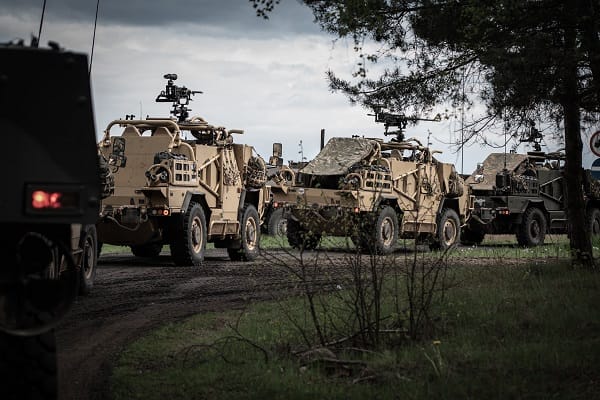
Britain’s armed forces are being forced to contemplate future warfare without the resources to properly prepare for it, a former senior military commander has warned, claiming there will be “no money for new weapons until 2030”.
General Sir Richard Barrons, who helped author the Strategic Defence Review, said the Ministry of Defence had moved “backwards” since its publication last year and warned that chronic underinvestment was undermining Britain’s defence capability.
Speaking to The Times, Sir Richard said the financial constraints facing the armed forces were so severe that the Army, Royal Navy and Royal Air Force were effectively limited to planning rather than implementing measures to achieve modern combat readiness.
He argued that while traditional military equipment such as tanks, artillery and helicopters remained funded at a basic level, Britain could not afford the “expendable” systems expected to dominate future warfare — including autonomous drones and loitering munitions.
The Army’s future capability model, outlined by Chief of the General Staff General Sir Roly Walker, is based on a “20-40-40” structure, where only a fifth of combat power would come from traditional platforms, with the majority relying on lower-cost, attritable systems.
However, Sir Richard suggested that this transformation risked stalling due to a lack of funding for the crucial remaining 80 per cent of capability.
He warned that defence companies were already shifting operations abroad in search of contracts, draining the UK of industrial expertise needed for future military development.
“There is no money now, and there may not be any money for four years,” he said, adding that firms were “following the money” to Germany, Poland and the United States.
His comments were supported by fellow Strategic Defence Review co-authors Lord Robertson of Port Ellen and Dr Fiona Hill, both of whom have separately raised concerns about Britain’s preparedness for a more unstable global security environment.
Lord Robertson has previously accused the Government of “corrosive complacency” on defence, while Dr Hill has warned that Britain risks falling short on resilience amid growing geopolitical threats.
Sir Richard said Britain required an additional £10 billion annually to modernise its forces effectively, dismissing current projections for increased spending as insufficient to meet long-term needs.
He warned that meaningful increases in defence spending would not arrive until the government’s planned uplift to 2.5 per cent of GDP in 2027, and even then, would largely stabilise existing commitments rather than fund transformation.
He contrasted Britain’s position with Germany, which he said was set to significantly outspend the UK on defence by the end of the decade, strengthening its industrial base and military capacity.
An Army source disputed some of the assessment, insisting that investment in new procurement programmes was already underway and accelerating.
However, Sir Richard concluded that Britain remained “still either in denial or incapable of sorting itself out for the world we now live in”, warning that continued delays risked eroding both military capability and the country’s defence industrial base.


Leave a Comment