
Poland is to begin distributing a 12-page guide telling civilians what to do during an air attack, where to seek shelter and how to prepare for an emergency, as Russian strikes continue to hit areas close to the country’s border with Ukraine.
The special instructions will be distributed from Friday, September 25, through government websites and local authorities, with materials also handed out during civil-protection events and national and regional exercises.
Magdalena Roguska, Poland’s deputy interior minister, stressed that the document is not intended to replace the country’s existing safety handbook but to supplement it.
The guidance urges Poles to familiarise themselves with warning signals before an emergency occurs and identify the location of their nearest shelter and the safest route to reach it.
Read more related news:
A second NATO country is preparing emergency evacuations as Europe braces for war
US deploys ‘large numbers’ of troops and tanks ‘on NATO’s eastern flank’
Poland braces for the worst and evacuates two border crossings amid Russian missile strikes
Families are advised to agree an emergency plan, establish a meeting point and rules for communicating if normal networks are disrupted, and prepare an evacuation backpack containing essential supplies and medication.
If an air threat is announced and there is sufficient time to reach a shelter safely, residents are advised to take their emergency backpack and medication and use stairs rather than lifts.
Where reaching a shelter quickly is impossible, the guidance tells people to remain inside a building with sturdy walls, following the “two-wall rule” to place additional material between themselves and an external blast.
The instructions also set out what civilians should do if an explosion occurs while they are outdoors.
People caught on the street are advised to immediately lie down, preferably in a low-lying area, and protect their heads.
Those in vehicles are told to leave as quickly as possible and move towards the nearest safe location.
The Interior Ministry is also urging citizens to follow instructions issued by the Government Security Centre and other official emergency services.
The measures come as Poland has already begun conducting practical civil-protection exercises in areas close to its eastern frontier.
Exercises were held last Saturday in the Lublin and Podkarpackie regions, with further drills planned in Podlaskie and Warmian-Masurian voivodeships.
The preparations have taken on greater urgency after Russian attacks on western Ukraine triggered temporary evacuations at two Polish border crossings on Thursday.
The Dorohusk and Zosin crossings were evacuated as Russian strikes unfolded close to the Polish frontier, with border operations suspended and people removed from the sites before traffic was subsequently restored. Polish authorities described the closures as a standard security response to an aerial threat in the border region.
Prime Minister Donald Tusk said the latest attacks demonstrated the need for European governments to prepare for a prolonged period of heightened security risk.
“During my talks with Prime Minister Radev, Russia again attacked Ukraine near the Polish border. We evacuated the border crossings in Zosin and Dorohusk,” Tusk said after meeting Bulgarian Prime Minister Rumen Radev in Warsaw.
“This situation means we must act consistently and warn our European partners that this is a difficult time and that we must prepare well for the coming months.”
Tusk said autumn and winter could prove “truly critical” as Russia continues its attacks against Ukrainian infrastructure and logistics.
The warnings have also prompted senior Polish officials to discuss their own preparations.
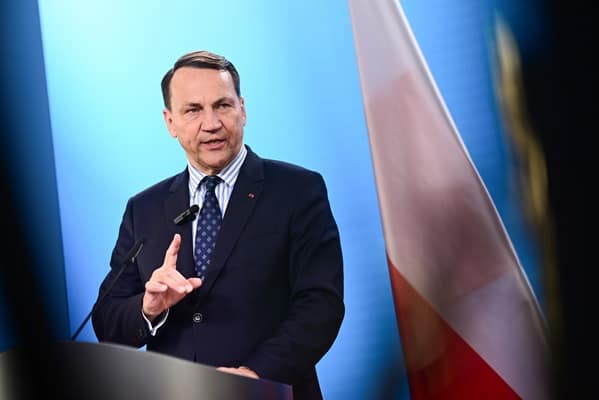
Foreign Minister Radosław Sikorski said he had stocked basic supplies at home and identified his nearest shelter.
“I have stocks of rice, I have a hand pump at home, and I have also made preserves from fruit from my own garden,” he said.
“I have the safety instructions, and I have also thought through where the nearest place of shelter is. Everyone should also know how to apply a dressing. That is useful even in peacetime.”
Asked whether ordinary Poles should prepare emergency bags, Sikorski urged people to follow official government guidance when authorities advise them to prepare for periods of instability.
“That is my appeal — to listen to it,” he said.
The latest measures underline how the war in Ukraine is increasingly shaping civil-defence planning beyond the battlefield.
Poland has already placed its air-defence and military aviation assets on heightened readiness during periods of intense Russian bombardment of Ukraine, while its authorities have repeatedly warned that attacks close to the frontier can require immediate precautionary measures. Reuters reported earlier this month that Poland had conducted preventive military aviation operations in response to Russian strikes, with ground-based air-defence systems and radar units also placed on heightened readiness.
The new civilian guide represents another step in that preparation: rather than treating air-raid protection as a contingency confined to Ukraine, Warsaw is giving the public practical instructions for responding if an aerial threat reaches Polish territory.


Leave a Comment