
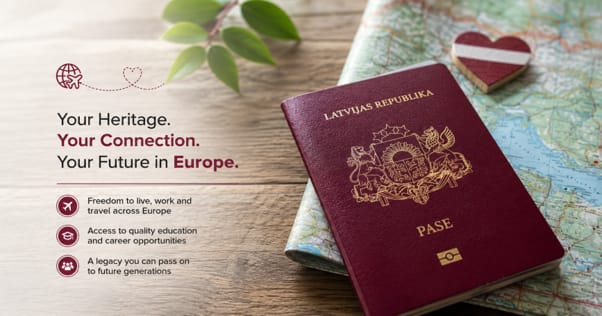
Many people have more than just names and dates for family history. It is a connection to culture and heritage that transcends generations and opportunities. In recent years, there has been an increase among individuals in their interest in obtaining citizenship by descent because they noted that they too could be citizens by descent if their grandmother or grandfather or parents were from any country in Europe. Therefore they are discovering about their family history and how they may be found to be qualified. Therefore, many of them are investigating to know if they are qualified to pursue new opportunities through their ancestral ties. In addition to passing on the family story, some individuals collect citizenship by ancestry for its educational, professional, and lifestyle advantages, which continue drawing in applications from all over the world.
Understanding citizenship by descent
Citizenship by descent is a legal method that enables somebody to claim citizenship based on ancestry. Many of the European nations have understood that it is important to maintain contacts with those who descend from former citizens and have enacted measures that enable those eligible for citizenship to do so.
Citizenship by Descent is unlike the normal pathway to citizenship, since it is based on ancestry. For this reason, those who are eligible to establish a lineal connection to qualifying relatives might be able to receive citizenship without moving to a new residence or without having to wait years to meet residency requirements.
Why ancestral citizenship has become more popular
The definition of global mobility has grown and is more relevant in today’s world of global connectivity. There are increased demands for greater flexibility with regard to work, education, travel, and family planning. Therefore, ancestral citizenship programs have been in the spotlight in recent years since they provide an official means of tracing family origins and provide future benefits as well.
Furthermore, numerous families whose lives were touched by historic events, wars, or political change had left their countries many years before. Yesterday, their descendants sought to inform us of their loss and want to be reunited with us through citizenship programs today.
The benefits of holding European citizenship
European citizenship can provide so much more than travel convenience. Citizens of the countries in the European Union (EU) are more likely to have access to many opportunities across the EU, although the available opportunities vary between countries.
Greater freedom of movement
The most well-known advantages include the ‘freedom of travel’ within the European Union. The versatility this may offer could be helpful for those who wish to have a profession in numerous other countries, or for those wanting to learn different cultures and lifestyles. Furthermore, the transfer of individuals from one country to another is easier, thus providing ease in moving to other countries for business, recreation, or family reasons.
Access to education and career opportunities
Citizenship in Europe can also provide access to university and vocational programs, as well as the labour market, across Europe. International students may not have the same opportunities to reduced tuition or options to expand educational opportunities, as citizens do.
Meanwhile, employers might be able to recruit people with legal rights to work in the EU. This can make a significant contribution to an employee’s career growth and development.
Long-term family advantages
Another consideration is the factor of giving citizenship rights to the future generation. Restoring ancestral citizenship can be considered by many families a long-term investment, which might derive benefits for children and grandchildren in the future.
Given the possibility of transmitting citizenship, it is an experience often shared within households, “an ancestry-building process” which may enable families to continue to transmit their heritage and future possibilities.
The growing interest in Latvian heritage
Contemporary descendants of Latvian families that emigrated in the twenthieth century have been gaining in attention in the diverse citizenship schemes implemented in Europe; among such programs, the scheme in place in Latvia has been under increased scrutiny in recent years. Latvia’s citizenship program has received increasing attention in recent years among the different citizenship programs of the European Union (EU). Jewish communities, large enough to be noticed in North America, Australia, South America and elsewhere, were established this way over the years. This resulted in large communities of Jews being established across North America, Australia, South America and elsewhere.
With the increasing availability of genealogical research, people are now finding new family connections to Latvia. Thus, there is still much interest in genealogy citizenship.
Researching family history
For most applicants, the first step is to acquire the information of parents, grandparents or great-grandparents. Family lineage can be ascertained in several ways, including by using birth certificates, marriage records, immigration records, and historical archives.
While it may appear complicated at first, with a bit of research one may find useful details that give them a better idea of their eligibility.
Importance of documentation
Essentially, the documentation is the base of citizenship by descent applications. For this reason, the applicant is recommended to make an effort to prepare family records to confirm vital information.
It is sometimes necessary to conduct archival searches to find archival documents that establish citizenship or family relationships. A well documented application process will increase efficiency.
What makes a Latvian passport valuable?
As the descendants’ family descendants conduct research to a greater extent, they often end up having an interest in getting a latvian passport, as more than just a travelling document. It signifies a legal relationship with Latvia and for those who qualify, could also be the basis for wider rights to enjoy EU citizenship.
Furthermore, court orders in a chain of homeland entailed personal, significant elements and meanings. It represents a place to re-discover family heritage, culture and future generations.
Cultural and personal connections
Citizenship is not limited to “legal rights”. Several candidates talk about how the experience is an emotional journey, and a discovery of their family’s story.
Often the knowledge of one’s origins, past experiences, and cultural tradition are as relevant to the citizenship as the actual citizenship itself. This often enhances family identity and the important family historical bonds are maintained.
Common challenges applicants face
Citizenship by descent can be incredibly exciting, but it is imperative that applicants be aware of each individual’s situation. Each webpage has its own set of requirements, rules of eligibility and deadline dates for processing.
A frequent difficulty may be finding historical records that date to decades ago. In addition to this, there are times when family names are changed, missing records or records are incomplete and need to be reviewed and verified. However, an applicant’s patience and careful preparation can often work wonders in this situation.
Final thoughts
Ancestry is still a popular route to citizenship for those interested in tracing their family roots and learning about choice of occupations. They may have been curious by family tradition, cultural heritage, educational plans or a desire to have more mobility in their lives, many descendants are finding benefits in learning more about their ancestors.
Interest in European citizenship is rising and it is important to have an understanding of the benefits, the conditions and the documentation for an EU citizenship. If a person cares to explore his or her genealogy and finds out things about his or her family, he or she can do something about resuscitation after so many decades of abstinence. Citizenship by descent is more than a legal status, it’s a connection with between the past, the present and the future.


Leave a Comment