
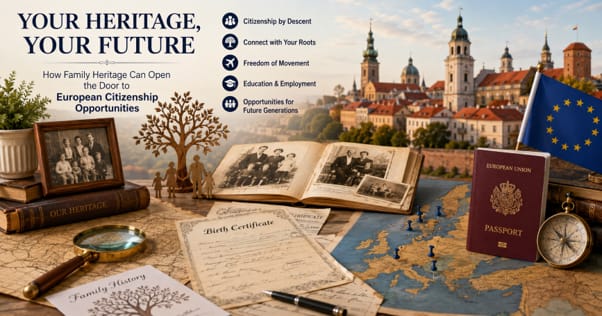
With modern technology this is an era where many are giving the subject of their family history a closer look. Peace and quiet, which was believed to be a hobby has become a practical exploration of new opportunities. In several countries within Europe, those who are descendants of citizens can restore the citizenship. In some countries, citizenship can be restored to descendants of citizens. Through this process thousands of people have been moved to search for their genealogy and make links they never would have made otherwise. Aside from legal qualification, citizenship by descent may be a powerful tool for establishing a clear connection with family roots, cultural identity and future prospects. With growing interest, knowledge about the nature of ancestry based citizenship is more significant than ever.
Exploring your right to citizenship through ancestry
Citizenship by descent is a law in a country that grants citizenship to people on the grounds that their parents, grandparents or other close relatives were citizens. This immigration avenue differs from the traditional one, as it is based on familial connections instead of residence or work.
Descendants abroad are recognised in many European countries, because of the historical ties. So they offer laws and guidelines under which a legitimate person may take or regain citizenship on the basis of previous family.
Why more people are exploring their ancestry
In the past 10 years, genealogical work has made an immense amount of progress in making research much easier. Family history is more accessible than ever before with online archives, historical databases and digitised family history records.
This has led to numerous people finding relations that can help them secure citizenship through a citizenship program. Moreover, with the rise in the interest of international mobility, people have opted to look at all possibilities that were not seen earlier.
Preserving family heritage for future generations
Family heritage is more than a collection of old records. It’s a repository of experience, traditions and cultural values which passed on through generations.
Where someone does their family history, they learn things that confirm their understanding of family history. Citizenship restoration thus is not just a legal endeavour, but also an embrace of family history.
Strengthening cultural identity and personal connections
A lot of children of the former empires see a lot of importance in countries their forebears lived in. Appreciation for culture and heritage is often fostered when learning about the family traditions, language and history.
Furthermore, there is a possibility that a Gibson’s citizenship restoration along with maintenance and strengthening of these relationships, could be beneficial for future generations and preserve the family’s history.
Benefits associated with European citizenship
There are many benefits to enjoying European citizenship that can be enjoyed by people from a diverse background. The rights of citizenship depend on the country but generally have more flexibility and access to the European Citizen in countries within the European Union.
Freedom of movement
The best known of these is the ability to move about Europe more easily. Many citizens of European Union member states are able to enjoy the right of free movement in other EU member states for purposes of living, working and studying without being subjected to obstacles that are not strictly necessary. This flexibility is a great benefit to others who wish to pursue opportunities outside the country either as entrepreneurs, students, families, or professionals.
Access to education and employment
Higher education in Europe continues to be very appealing. Numerous universities have top-notch academic degrees, research and study possibilities, and highly valued qualifications.
Likewise, greater employment markets can also open up other job prospects. Citizenship can, therefore, contribute to long term personal and professional development.
Opportunities for future generations
Another significant benefit is the transfer of citizenship to children and grandchildren. For some families citizenship restoration is considered a long-term legacy that could benefit the succeeding generations.
This is often what makes the process something that many applicants believe is a sensible, and significant, return on their family’s investment.
Why Lithuania continues to attract global interest
Lithuania has a long historical heritage of cultural resilience, settlement and national identity. In the twentieth century, a lot of Lithuanian families left Lithuania to settle in many parts of the globe for various reasons, including political or economical.
Today, descendants of those emigrants are increasingly researching their family roots and exploring whether they qualify for lithuanian citizenship by descent. Increasingly, people are making an effort to discover their ancestral roots, as well as the legal rights to which they have access through family history.
Historical migration patterns
Lithuanian communities are large in North America, South America, Australia, the United Kingdom etc. The Lithuanian communities are widespread in North and South America, Australia, the United Kingdom etc., and are large in number. A large part of the family is still connected, and continues to practice a way of life like that of Lithuania.
Hence, many people are looking back at archive records and family stories to ascertain their eligibility.
The role of genealogical research
Ancestry related citizenship applications can be based on genealogical research. Family connections can be documented from birth certificates, marriage records, immigration documents and census records.
Taking the time to collect these kinds of records can be a challenge and can take effort but often will produce really interesting information about your family’s history that you would be unlikely otherwise to find.
Challenges in tracing family history and documentation
Although citizenship through ancestor is an interesting yellow brick road, during the documentation process, there are some hurdles that can present themselves.
History records may contain gaps, may be damaged or may be hard to find. Further, inconsistent naming, language barriers and the migration history may all present challenges for research. But these hurdles can, however, be necessarily surmounted with careful preparation and careful record collection.
Building a strong application through proper records
When creating family lines, proper documentation plays a crucial role. It is important that applicants check all records, before entering any formal process.
Having this type of information (relationships between generations) presented in a way that is evident in supporting documents can make the application more compelling and thus lead to fewer delays.
The lasting value of reconnecting with your heritage
Although citizenship rights and traveling opportunities grab the headlines, many others discover the psychological positive facets fascinating, too.
Knowing family history will increase people’s appreciation of their own culture, family history and identity. But in most situations, a person feels more attached and connected when they have a better understanding of their historical background.
Families telling their stories and documenting history, helps future generations understand their past and the journeys it has taken.
Conclusion
Rights of citizenship compiled as family heritage remains intriguing to those who want to benefit from an opportunity and become part of an important heritage. The study of family history within the field of Genealogy reveals helpful clues to understanding past generations, based on knowledge of the available routes.
Ancestry-based citizenship not only uses a traditional path to manage cultural identity and education but also reflects people’s choices of global mobility and family legacy. Increasingly, people realise that the story of their ancestors can still impact their lives in unusual ways in the future.



Leave a Comment