
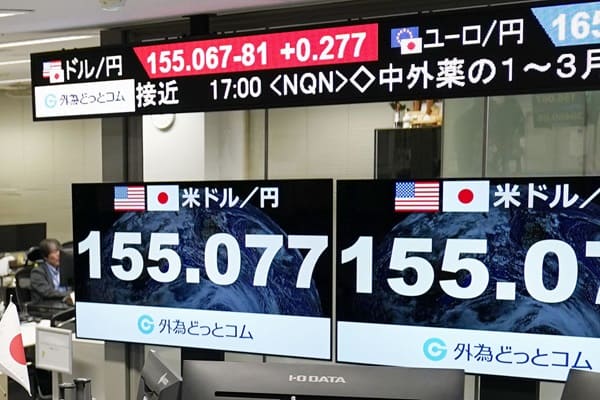
The USD/JPY pair declined modestly at the start of Thursday’s trading session, trading at 155.91 after reaching its highest level in three months.
This decline raises questions about the impact of recent Japanese inflation data on the stability of the yen. In my view, the unexpected rise in Japan’s Producer Price Index (PPI) for October signals a potential shift in inflation, which may prompt the Bank of Japan (BoJ) to consider extraordinary measures to curb inflation.
We can now anticipate a potential interest rate hike, which could strengthen the yen significantly. The increase in producer prices adds further pressure on Japan’s economy and may lead policymakers to reassess monetary policy to enhance financial stability.
On the other hand, the US dollar remains supported by US inflation data, which indicates ongoing inflationary pressure, increasing the likelihood of the Federal Reserve maintaining its current policy.
Although US inflation readings matched expectations, the continued rise in consumer prices challenges the Fed’s stance on rate cuts. In my opinion, these data make it unlikely that the Fed will cut rates in the near term, as addressing inflationary pressures remains essential. The dollar may benefit from these conditions, potentially maintaining stability against major currencies, though global economic and political tensions could lead to limited fluctuations.
Despite the recent dip in USD/JPY, the pair’s upward trend remains intact in the short to medium-term. The dollar gains support from market expectations that the new fiscal policies of President-elect Donald Trump’s administration will lead to inflationary pressures. Policies such as protectionism, high tariffs, and tax cuts may drive domestic spending, supporting inflation and reducing the pressure to cut rates. This shift in US fiscal policy could reduce the likelihood of a significant rate cut, supporting the dollar against other currencies, including the yen.
In Japan, the Producer Price Index exceeded expectations, rising 3.4% year-on-year and 0.2% month-on-month in October. This increase reflects inflationary pressures that may soon affect consumer prices, challenging the BoJ, which has long sought to stimulate the economy through easy monetary policies.
These data put the BoJ in a difficult position, balancing economic growth with rising inflation. In my view, any signal from the BoJ to raise rates would attract capital inflows, naturally boosting the yen. However, a rate hike also poses risks to Japan’s economy, which continues to face structural challenges impacting growth.
In the United States, while the Consumer Price Index (CPI) data met expectations, it indicates persistent inflationary pressure. The headline inflation rate rose to 2.6% year-on-year, with core inflation at 3.3%. These figures underscore that while inflation is under control, it remains relatively high, supporting expectations for continued monetary tightening in the US. This data adds complexity to the economic landscape in the US, as the Fed must carefully weigh decisions to avoid negative impacts on growth. If the Fed maintains its firm stance on inflation, the dollar may remain strong against other currencies, especially the yen, given the monetary policy divergence between the two countries.
The recent minutes from the BoJ meeting, released on Sunday, reveal a clear divide among officials regarding the timing of a rate hike. While BoJ Governor Kazuo Ueda emphasises that rates will rise if economic data aligns with expectations, the central bank maintains its forecast to raise rates to 1.0% by the second half of 2025. I believe the BoJ may seek a gradual rate increase, depending heavily on inflation staying within a controllable range. If inflationary pressures escalate further, the BoJ might accelerate rate hikes to mitigate economic risks.
In conclusion, USD/JPY remains influenced by varying factors, including the fiscal and monetary policies of both the US and Japan and the inflationary challenges facing both countries. While the US dollar appears likely to hold its support in the short term, any policy shift from the BoJ toward rate hikes could strengthen the yen and reshape the pair’s balance. Markets will likely closely monitor new data from both sides, as inflation will play a critical role in shaping monetary policy decisions and their impact on global currencies.
On the 4-hour chart, the USD/JPY pair continues to develop its third wave of growth, targeting the 156.15 level. Once this level is reached, we anticipate the possibility of a correction down to 154.15. Following this, a new wave of growth towards 157.00 is expected. Technically, the MACD indicator supports this scenario, with its signal line positioned above zero and trending upwards.
On the 1-hour chart, the market has formed a sideways consolidation range around the 155.95 level and continues to develop a wave towards 156.15, with a breakout to the upside. After reaching this level, we anticipate a correction towards 154.15, with an initial target of 155.20. This scenario is technically confirmed by the stochastic oscillator, where the signal line is above the 50 level and pointing upwards.
In the current technical outlook, the USD is showing increasing bullish momentum, with potential for further gains towards new highs. The unexpected boost in upward momentum has pushed USD/JPY to 155.95, signalling a strong continuation of the uptrend. I expect the price to reach the key resistance level at 156.00 in the medium term. The main support level remains at 154.00, reinforcing the continuation of the current uptrend. Any retracement is expected to be limited to this level or near it, with secondary support at 154.35.
In the longer term, with sustained bullish momentum, the USD may reach 156.00 in the coming days. The increase in momentum suggests a potential breakout beyond the previous trading range, which has been between 151.30 and 156.00. To maintain this positive momentum, the USD needs to stay above the strong support level of 153.35. Holding above this level would strengthen the uptrend, reflecting continued buying pressure on the dollar and supporting this direction in the medium term.
Support Levels: 155.76 – 155.061 – 154.45
Resistance Levels: 156.12 – 156.70 – 157.12


Leave a Comment