
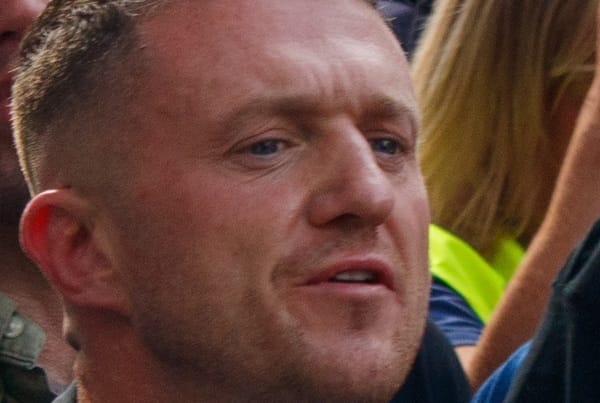
Tommy Robinson has claimed he was detained and questioned by police at Heathrow Airport under counter-terrorism legislation, reigniting debate over the use of sweeping border security powers.
The activist, whose legal name is Stephen Yaxley-Lennon, said he was stopped on arrival at London’s busiest airport and had multiple electronic devices seized by officers acting under powers contained within the Counter-Terrorism and Border Security Act 2019.
Robinson alleged that both his iPhone and Samsung Galaxy devices were confiscated during the encounter.
Shortly after his release, he appeared to reference the prospect of further legal proceedings, sharing a fundraising appeal online and writing: “So here we go again, looks like more defence and court fees.”
The powers in question allow officers at ports, airports and border crossings to stop, question and search individuals in order to determine whether they are involved in hostile activity on behalf of a foreign state or in terrorism-related activity.
Unlike many other police powers, the legislation permits extensive questioning and examination at the border without the requirement for a prior arrest.
The reported detention comes at a time when Robinson’s online profile has once again been growing, with his social media accounts attracting increased attention over recent weeks.
His supporters reacted angrily to news of the stop.
A spokesman speaking on Robinson’s behalf suggested authorities were interested in identifying his contacts and sources.
Posting on X, the spokesman claimed: “They likely want to see who he is talking to, and maybe find out who his sources are.”
The spokesman further alleged that the detention represented “an attack on free speech” and “an attack on investigative journalism.
The Metropolitan Police declined to provide details regarding the circumstances of the incident when approached for comment.
Without further information from police, it remains unclear why the powers were exercised, what questions were asked, whether any devices remain in police possession, or whether the stop forms part of a wider investigation.
The episode is nevertheless likely to fuel fresh political debate over the use of national security legislation and the balance between public protection and civil liberties.
However, last week Robinson sparked fresh controversy after travelling to Moscow and allegedly declaring that “Russia is not the enemy of Britain” while appearing alongside Elon Musk’s father.
The far-right activist was filmed with Errol Musk in what appeared to be the bar of a luxury Moscow hotel just days after encouraging supporters to join protests across Britain following unrest in Belfast.
In the video, Robinson is seen sitting alongside the South African businessman while praising Russia and dismissing concerns about the Kremlin’s hostility towards the West.
“Russia is not the enemy of Britain,” Robinson said.
The footage is understood to have been filmed at Moscow’s prestigious Metropol Hotel, one of the Russian capital’s most famous luxury establishments, where rooms can cost hundreds of pounds per night.
The appearance is likely to fuel criticism of Robinson’s increasingly public association with figures sympathetic towards Vladimir Putin’s regime.
Robinson has previously expressed admiration for Russia and has appeared in interviews linked to pro-Kremlin circles. He was interviewed by the Brotherhood of Academists, a nationalist group founded by Konstantin Malofeev, a Russian oligarch sanctioned by Britain and other Western governments.
Successive governments have argued that border examination powers are a vital tool in tackling terrorism, hostile state activity and organised threats to national security.
Critics, however, have long warned that the broad nature of the legislation risks capturing journalists, campaigners, activists and political figures who are not accused of any criminal offence.
For Robinson, a figure who has spent years at the centre of battles over free speech, immigration and policing, the Heathrow incident is likely to become the latest chapter in a long-running confrontation with the authorities.
Whether it proves to be a routine security examination or the beginning of a larger legal dispute remains to be seen.





Leave a Comment