
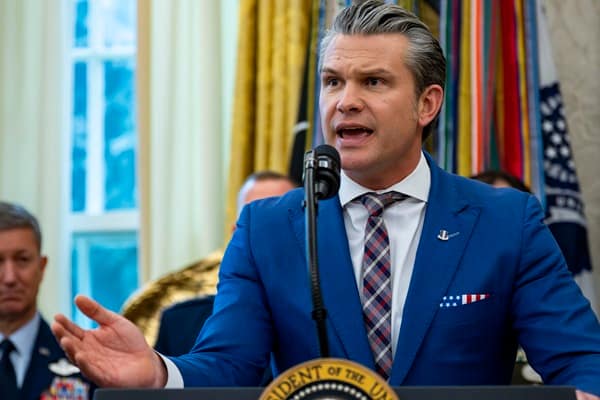
Just over a year ago, the now infamous Oval Office exchange between Donald Trump, Vice President J.D. Vance and Ukrainian President Volodymyr Zelensky captured a shift in tone that many in Europe had long feared.
During that meeting, Vance publicly challenged Zelensky, asking whether he had “said thank you” for American support.
The moment travelled around the world instantly, but for Ukrainians fighting a war of survival against Russia, and for European allies who had spent years coordinating military and humanitarian support, the exchange felt less like diplomacy and more like a public rebuke.
It set the tone for a year of increasingly disjointed messaging from Washington, something that has become synonymous with the Trump administration. Trump’s team repeatedly questioned the scale of Western support for Ukraine, criticised NATO partners and even dismissed allied sacrifices in Afghanistan.
The narrative from the White House was clear: Europe should shoulder more of the burden and American involvement overseas should be limited.
Yet events have a habit of colliding with political messaging, particularly when it comes to Ukraine. In recent days, comments from White House Press Secretary Karoline Leavitt have added another layer of contradiction. While defending the administration’s broader foreign policy approach, the Pentagon has quietly acknowledged a growing problem: Iranian-designed one-way attack drones.
At the same time, Leavitt claimed that “We had a stupid and incompetent leader in the White House for four years, [who] gave away our best weapons for nothing, for free, to another country very far away.”
The current administration appears completely lost, meeting itself coming back. It does not seem to grasp the predicament it now finds itself in and still blaming Biden & Ukraine 🤦♂️ pic.twitter.com/v0IW1P8lJm
— Shaun Pinner (@olddog100ua) March 5, 2026
The remark is demonstrably inaccurate, but it reflects the continued political framing that seeks to blame both Ukraine and the previous administration for the strategic situation the United States now faces. The same Shahed-type loitering munitions that Russia has used relentlessly against Ukrainian cities, energy infrastructure and civilian areas are now increasingly seen as a threat to American forces and partners in the Middle East.
And now, in a striking twist, Washington is looking to Ukraine for expertise.
For more than three years Ukraine has lived under the constant threat of Iranian-designed Shahed one-way attack drones launched by Russia against cities, energy infrastructure and frontline positions. In response, Ukrainian engineers, air defence units and electronic warfare specialists have rapidly adapted, developing layered interception tactics, mobile air defence teams and electronic countermeasures specifically designed to defeat large waves of low-cost drones.
According to reporting from Reuters and U.S. defence officials, the Pentagon has recently examined Ukrainian battlefield experience in countering Shahed-type drones as American forces face similar threats from Iranian-aligned actors in the Middle East. Ukraine’s battlefield innovations, born out of necessity, are increasingly viewed as some of the most practical real-world lessons available for countering mass drone warfare.
Ukraine has become, by necessity, the world’s most experienced laboratory in defeating this kind of weapon. That reality now presents an uncomfortable irony for the Trump administration.
The same country that was publicly scolded for gratitude is now being approached for practical help dealing with the very technology used against it daily.
None of this should surprise military planners. Modern warfare evolves quickly, and Ukraine’s battlefield experience has made it one of the most innovative defence environments anywhere in the world. Western militaries have already learned extensively from Ukrainian developments in drone warfare, battlefield communications and rapid adaptation.
Politically, however, the optics are difficult for an administration that has gradually pulled away from supporting Ukraine, even going so far as to entertain an indicted ICC war criminal on American soil.
When an administration publicly questions the value of supporting a partner under invasion, only to later seek that partner’s expertise, it exposes a deeper problem: the widening gap between political rhetoric and strategic reality.
The reality itself being simple.
Ukraine has spent years confronting the exact threat that American forces are now grappling with. The lessons learned on the front lines of Kharkiv, Odesa and the Donbas may soon prove just as relevant in the skies above American bases in the Middle East.
Allies rarely forget how they are treated in moments of crisis, which is why the real question now is not whether Ukraine can help, it’s whether Washington’s messaging will finally catch up with the realities of the war it has spent so long trying to politically distance itself from.


Leave a Comment