
The Captivity
Hooded and bound, I was dragged into a room, my leg pulsing in agony, blood already clotted around the makeshift pressure bandage someone had improvised from a blue T-shirt and a length of Sellotape. I suppose I should thank my luck, or my captor’s twisted sense of decency, that the same Russian soldier who stuck a knife in me later decided to patch me up after a round of brutal questioning.
Maybe it was guilt. Maybe he just wanted me conscious for the next session. I’ll probably never know, but the punches and kicks to the wound after the blue T-shirt was taped to my leg didn’t make much difference. It may as well have been a fairground target with a buy one, get one free offer.

© Shaun Pinner
Make no mistake: when you’re captured and taken prisoner, you are no longer in control. It’s not like the films. There’s no dramatic music, no brave Arnie quip, no well-timed rescue, and definitely no overpowering the one stupid guard. What follows is a test of instinct, not heroism.
It’s never one guard. It’s three. All armed. All with batons, cattle prods, and an inflated sense of purpose.
Captivity strips you down to diplomacy and damage control, a delicate game of reading faces, if you can see them, and listening to tones and tempers in a room where every mistake can end with a rifle butt to the ribs. Everything becomes about sound: footsteps, breathing, the metallic click before the pain, and, of course, the Russian love for electricity.
Unpredictability becomes your worst enemy at the point of capture. You start thinking in seconds, not hours. One wrong word, one flicker of defiance, and the next decision made about you could be final.
Even something as simple as not understanding a basic command could cost you dearly.
“Сидеть!” — pronounced see-DYET — means to sit or to be sitting. Mishear that, or hesitate for too long, and within five minutes you could be nursing a broken rib… or worse.
Generally, three burning questions repeat over and over. Usually, they come from the media, but occasionally someone will work up the nerve to ask directly, skipping social filters, blurting it out with the kind of honesty you only get from curiosity that’s stronger than tact.

© Shaun Pinner
I don’t mind, and I’ll explain why.
- What’s electrocution and being tortured really like?
- Are you okay mentally?
- How do you come back from that?
The answers, like the memories, aren’t simple but to understand them, you first have to understand the system.
The Art of Breaking Men
It’s not like in the movies, as I said.
I wasn’t tortured for information, and anyone who’s ever been through it will tell you the same truth: torture doesn’t work. It’s been proven time and again, in every war, in every intelligence report worth its salt. Because the reality is simple: you’ll tell them everything they want to hear, and plenty they don’t, just to make the pain stop.

© Shaun Pinner
You’d admit to working with Elvis if that’s the line of questioning they wanted to pursue.
The Russians know this too. They don’t do it for information. They do it for control. For rhythm. For their own kind of theatre.
Enter the modus operandi – their method of operations.
Every part of it is rehearsed, deliberate, almost ritualistic. It’s not chaos; it’s choreography. One man asks questions. One inflicts pain. One watches. They document your reactions like scientists studying a specimen, more often than not recording it. You are not a human being anymore. Their aim isn’t to learn anything true; it’s to manufacture truth, to sculpt it into whatever story they need to justify their crimes. If you understand that, then already that’s a small goal, a small victory.
They wanted me to admit to things I hadn’t done, to name places I’d never been. Their goal wasn’t justice, it was legitimacy. Torture, in their hands, becomes paperwork and normal. A confession, no matter how false, is their stamp of approval for whatever headline they need to print the next day.
When your objective is to sanitise genocide, you don’t need truth, you just need a soundbite.
“Nazi.”
“Mercenary.”
“Terrorist.”
The words were hurled at me so often they became background noise, as common as hearing “Do you want a cuppa?” when I’m back home. It was their national vocabulary of hate, spoken with the same casualness as ordering breakfast. Only in this room, the language came with fists, cables, and electricity. They weren’t trying to make me speak. They were trying to make me disappear, to turn a person into propaganda, a name into a warning. After all, according to them, I was James Bond, MI6, or special forces. The paranoia was evident. I couldn’t possibly have been a Ukrainian Marine, married and settled in Mariupol. I had to be something bigger, better, and of course… a Nazi.

© Shaun Pinner
Being electrocuted is actually pretty quiet. No training in the world can prepare you for the pain — but, not surprisingly, nobody wants to touch you. You can’t scream because everything is wired shut. People are gawping at you; all you hear is the dit-dit-dit of the electric current. And you’re fully conscious through the whole thing, unable to move.
They say torture is about power, but in Russia, it’s about narrative. Every cable, every punch, every forced confession is a rehearsal for the next act, the trial by public opinion. Before you ever see the inside of a courtroom, you’ve already been convicted in the media. Your story, your image, even your voice become props in a show produced for home audiences, the same ones who switch between war crimes and weather forecasts without flinching.
By the time you’re paraded on camera, the world has already been told who you are: the mercenary, the Nazi, the foreign killer. The facts don’t matter. They’ve been edited out, replaced with something easier to hate.
My friend John once said, “Shaun, you know it doesn’t matter, they’ll dub you saying you kill Russian babies and Photoshop a red sash on your arm with a swastika.”
He wasn’t wrong.
What’s left of you is a headline and a clip that can be looped on Russian state television between missile launches and patriotic songs. I remember thinking, Shit, my mum might actually think I’m a Nazi. Not a good look.

© Shaun Pinner
That’s the point. Torture isn’t the finale, it’s the opening act.
The pain is just preparation for the performance that follows: the one where you sit in a cage under bright lights, surrounded by cameras, with a translator who lies for the state and a judge who’s already read your sentence.
A Russian courtroom isn’t a place of law. It’s a stage and everyone in it knows their lines.
So you sit there, bruised, hollow, fully aware, while the rest of the world debates your guilt or innocence like it’s a story they can scroll past.
The trial begins long before the gavel falls.
And in Russia, it always ends the same way.
You don’t walk out.
You’re paraded out, trailed by a gaggle of courtroom press and twenty guards armed to the teeth, as if Brad Pitt had just been given a DUI verdict and was being met by J-Lo outside the courthouse.
Click. Click. Click…
The Trial Before the Trial
If torture was the rehearsal, this was opening night.
They called it a courtroom, but it was closer to a film set, only the lighting was worse and the audience didn’t clap.
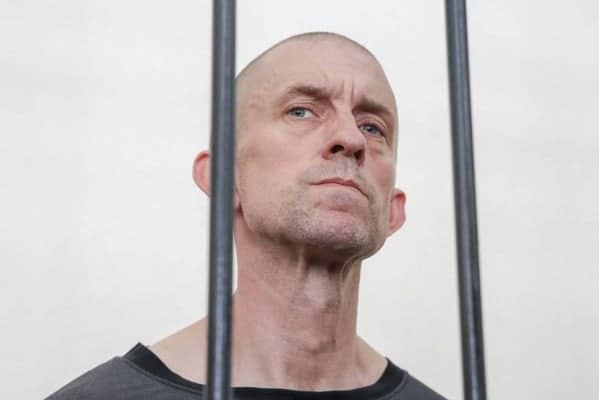
The cage stood at the end of the room, a welded box of humiliation, the kind you’d expect to see in a zoo if the animals inside were human. The irony wasn’t lost on me. They claimed to be civilised, and yet there I was, penned in like a specimen behind glass for a story they’d already written. I carried the scars of the most brutal treatment and weighed barely sixty kilos after nearly two months on a diet of bread.
The faces around me were familiar, the same guards, the same handlers, even the same camera crew from the “interviews” they’d filmed earlier under duress. It was like walking onto the set of a sequel no one asked for.

© Shaun Pinner
They called it due process, but everyone in that room knew it for what it was: choreography. The prosecutor spoke as if auditioning for an award; the translator twisted every word I said into something convenient. Even Brahim, a fluent Russian speaker on trial with us, argued that she wasn’t interpreting what we were saying, but the head judge just nodded along as though he’d been briefed the night before. He was flanked by two others who’d clearly already made up their minds.
It became obvious when the female judge referred to me as a terrorist, “Get this terrorist out of my way”, as she left the courtroom, accidentally bumping into me on the way out. As if I had any control, handcuffed and bent over in an arm lock.
It wasn’t a trial. It was a script reading.
Every accusation had already been rehearsed. Every photograph, every clip, every “confession” had been edited for the right tone of villainy. I could have sung the Ukrainian national anthem backwards and they’d have translated it as an admission of guilt.
The cameras rolled constantly, not for record, but for propaganda. My job in this production was simple: look defeated. Look dangerous. Look foreign.
That was the character I’d been cast to play, the British mercenary, the Nazi invader, the proof that Russia was “defending itself.”
They made me get ready for the trial. It wasn’t about dignity; it was about optics. The Russians love a good presentation. They told me to clean up, to look “presentable,” which, given the circumstances, was a bit of a joke. A cracked mirror was propped up on the wall of the washroom, probably so I could appreciate the state I was in.
It was the first time I’d seen myself in months.
For a moment, I didn’t recognise the man staring back. My face was gaunt and bruised, my eyes sunken and ringed with exhaustion. My hair had been shaved unevenly, patches of scalp showing like a bad DIY job done by someone in a hurry, which, to be fair, it was. My clothes hung off me; I’d lost so much weight that the fabric seemed to belong to someone else, and my back went straight into my legs.
Boy, I looked bad.
It wasn’t self-pity. It was more like curiosity. I studied the reflection like a stranger you pass on the street but can’t quite place. I wasn’t seeing myself; I was seeing the version they’d made of me, bruised, hollow, sitting upright in that metal box in the courtroom. The image was surreal. I didn’t even look human anymore. I looked like the villain they wanted me to be and one of those pictures of freed prisoners from Auschwitz, and that’s when it probably hit me, the real trial wasn’t happening here. It had already happened: on television, in headlines, in living rooms. This was just the encore.
My army training had prepared me well, but when it’s real, happening to you, this emotional rollercoaster was starting to take its toll. The verdict had been written long before I ever stood in that cage. All that was left was to act it out. So it didn’t really come as a surprise when they gave me the death penalty. I was angry, extremely angry, for days.
Then, wallop.
When the moment finally came, when I was alone and the noise had gone, I collapsed. Not from fear, but from everything that had been held back.
Emotionally. Finally. I was broken.

© Shaun Pinner
So, when people often ask me why I still talk about it. Why I go back over it, piece by piece, when I could just as easily lock it away and get on with life.
The truth is, I don’t really have the luxury of silence.
I owe it, to the friends still in captivity, to the families still waiting for news, to the ones who never came home. I owe it to the soldiers who will one day face what I faced, whether they wear the trident of Ukraine or the patch of NATO. Maybe if they hear it from someone who lived it, they’ll understand what Russia truly is before they meet it face to face.
Russia didn’t just make me a survivor. It made me an activist.
I never set out to be political. I was a soldier, a husband, a bloke from London who happened to speak Russian because life took me east and love kept me there. But when you’ve been through their system — when you’ve seen what they do and how they lie — neutrality isn’t an option.
So yes, Russia made me Russophobic.
And they earned it, except now, there are many like me, who lost far more.
They wanted to turn me into propaganda, but what they actually did was give me a voice. Every interview, every article, every speech I give now, it’s my answer to them. A slow, deliberate act of defiance.
They broke my body, but not my purpose.
And if speaking out means someone else understands the cost of this war a little better, then it’s worth reliving the fire.
That’s why I don’t mind talking about it.
Because they tried to silence me and instead, they amplified me.

© Shaun Pinner
To be continued in Part Three: “The Reconstruction of a Man” ….
Shaun Pinner BIO: Author, Public Speaker, and Recipient of Ukraine’s “Order of Courage” for selfless acts in the defence of Ukrainian sovereignty.
A proud husband and father born near Watford, England, I served for nine years in the British Army’s Royal Anglian Regiment, including deployment with the UN in Bosnia during the early ’90s. Trained in Survival, Evasion, Resistance, and Escape (S.E.R.E.) as part of the 24 Airmobile Brigade, I continued my military journey by joining the Ukrainian Armed Forces in 2018 as the country rebuilt its military following the annexation of Crimea.
Initially serving as a Sniper Instructor with the Ukrainian National Guard in Mariupol, I transferred to the Ukrainian Marines in 2020—becoming the first foreigner to command a frontline position as a Ukrainian soldier. I passed all aspects of Ukrainian parachute training and earned the prestigious Blue Beret with the Air Assault Company of the 1st Battalion, Ukrainian Marines. On my fourth deployment and second as a Section Commander, I was stationed at a forward listening post when Russia launched its full-scale invasion in February 2022. I led a fighting withdrawal back to Mariupol over several days—a story recounted in my book Live. Fight. Survive.
The book details my life before Ukraine, my service on the frontlines, and the intense battle for Mariupol. Most powerfully, it recounts my capture, torture, and death sentence at the hands of Russian proxy forces (the so-called DPR), and my eventual release in a dramatic prisoner exchange brokered by Saudi Crown Prince Mohammed bin Salman, Roman Abramovich, and the Ukrainian government.
Since my release, I’ve been awarded one of Ukraine’s highest honours by President Volodymyr Zelensky. I now brief NATO forces and S.E.R.E. schools globally, speak regularly in the media on geopolitical developments involving Ukraine, and recently won a landmark legal case holding Russia accountable for my treatment in captivity. I continue to reside in Ukraine, supporting my Ukrainian wife in humanitarian efforts and standing firmly in support of the country’s future


Leave a Comment