
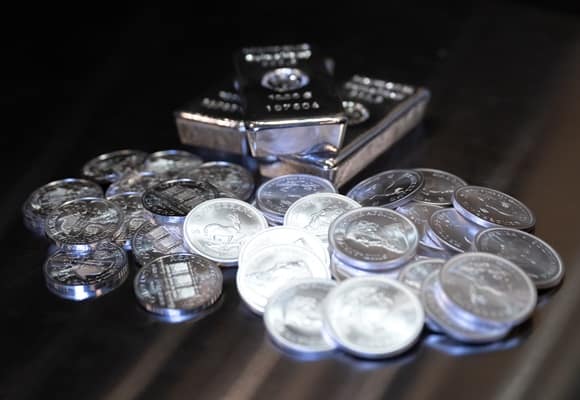
Silver prices are currently moving in a sensitive zone near the $76 per ounce level within XAG/USD trading, after touching a daily low of $72.61, in a scene that clearly reflects the weak bullish momentum that has characterised the metal’s movements over recent weeks.
In my view, this volatility is not just a temporary sideways move, but rather the beginning of a transitional phase in market behaviour, where silver is shifting from a risk-driven impulsive rally into a more complex revaluation phase governed by both fundamental and financial factors.
I also believe that geopolitical factors have played a dual and somewhat confusing role in silver’s recent movement.
On one hand, the failure of peace talks between the United States and Iran and renewed tensions surrounding the Strait of Hormuz have strengthened demand for the US dollar as a safe haven, putting direct pressure on silver. On the other hand, rising tensions typically support precious metals, but the paradox here is that silver has not benefited as strongly as gold, which in my view highlights silver’s greater sensitivity to dollar movements and real yields compared to gold.
In my assessment, the relative decline in silver prices despite escalating geopolitical risks indicates a shift in investor priorities, with increased focus on US monetary policy. Recent inflation data, particularly the Consumer Price Index, has shown persistent inflationary pressures, reinforcing the stance of Federal Reserve officials and leading markets to price in the scenario of keeping interest rates higher for longer. This factor, in particular, appears to be the most influential in restraining silver, as it is a non-yielding asset and therefore negatively affected by rising opportunity costs.
I therefore believe that silver may have begun building bullish momentum not purely due to physical demand, but also as a result of a recent oversold condition that triggered a rebound. The move above $76 followed a strong downward wave, meaning the current action could simply represent investor repositioning. However, continued trading without a clear breakout above higher resistance levels increases the likelihood of a short-term corrective phase.
On the other hand, long-term supportive factors for silver cannot be ignored, which makes me cautious about adopting a negative outlook. Industrial demand, particularly from clean energy and technology sectors, remains relatively strong, and any further escalation in geopolitical tensions could redirect flows back into precious metals. However, in the short term, I believe these factors are insufficient to offset the impact of a strong dollar and a tight monetary policy.
As for my outlook, I expect silver to remain in a trading range between $72 and $76 in the near term, with a slight bearish bias as long as pressure from the dollar and bond yields persists. A clear break below $72 would open the door to a deeper correction, while any bullish scenario would require a breakout above $80, supported by a strong catalyst such as a sharp decline in inflation or a shift in Federal Reserve policy toward easing.
In conclusion, I believe the question—whether this is a correction or a buying opportunity—cannot be answered in absolute terms, but rather depends on the investor’s time horizon. In the short term, I remain cautious and lean toward a corrective scenario, while in the medium to long term, any pullbacks may represent gradual entry opportunities, especially if prices stabilize near strong support levels. This view reflects my conviction that silver still maintains supportive fundamentals, but is currently undergoing a necessary and healthy revaluation phase.


Leave a Comment