
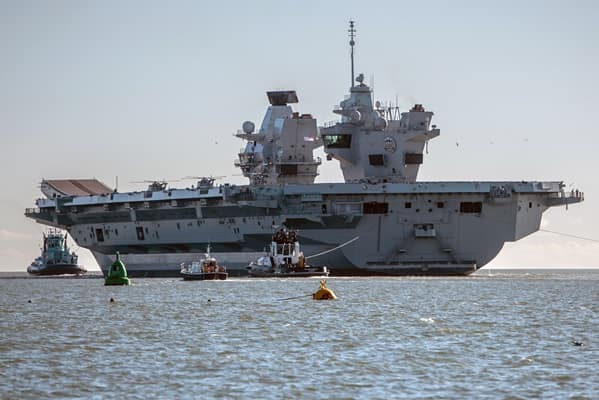
Crew members aboard Britain’s flagship aircraft carrier, the HMS Prince of Wales (R09), have been instructed to prepare for potential deployment within a tight timeframe of five days, in response to the escalating crisis in the Middle East.
This directive comes as tensions in the region heighten, particularly in light of the ongoing conflict involving Iran, prompting UK ministers to weigh the decision to send the £6 billion warship to assist in international military efforts.
Defence sources have raised concerns about the United Kingdom’s ability to assemble a full carrier strike group to accompany the HMS Prince of Wales.
Under standard operational protocols, a Royal Navy carrier deployment would typically be supported by two to three destroyers or frigates and an attack submarine to ensure adequate protection against threats.
However, current assessments suggest that the Royal Navy may require additional support from allied nations, including France, the United States, and other European partners, to provide sufficient escort for the aircraft carrier.
While the Ministry of Defence has confirmed that a final decision regarding the deployment has yet to be made, reports indicate that crews have already been alerted to the possibility of a mission in the Middle East.
This comes as the geopolitical landscape becomes increasingly volatile. Should the deployment proceed, the HMS Prince of Wales is expected to operate alongside HMS Dragon (D36), a Type 45 destroyer set to depart Portsmouth for the region within the coming week.
At present, the Royal Navy’s inventory includes six attack submarines; however, operational readiness is limited. Only HMS Anson (S123) is fully operational and currently stationed in Australia.
Among the Royal Navy’s surface fleet, only two ships—HMS Somerset (F82) and HMS St Albans (F83)—are reportedly available for immediate operations, while several other vessels are undergoing maintenance or facing various technical issues that hinder their readiness.
James Cartlidge, the shadow defence secretary, has criticised the situation, attributing it to years of underinvestment in the UK’s defence capabilities.
In his statement, he remarked, “The truth is Labour has prioritised welfare over defence, leaving an under-funded Ministry of Defence that has been forced to make £2.6 billion in cuts this year.
This is why there are currently no Royal Navy warships in the Middle East and why, even if a carrier were deployed, there would be serious questions about the availability of escort ships to provide adequate protection.”
These developments come on the heels of a conversation between UK Labour leader Keir Starmer and former U.S. President Donald Trump on Sunday, which focused on the rising tensions in the Middle East.
Trump had earlier taken to Truth Social to criticise Britain’s approach to the crisis, stating that the United States does not require allies “who join wars after we’ve already won.”
In response, a spokesperson for Downing Street confirmed that the two leaders discussed the ongoing situation in the Middle East and the future of military cooperation between the United Kingdom and the United States.





Leave a Comment