
Something has shifted in Moscow’s tone. The swagger is gone, but in its place is a more brittle, defensive narrative, something I’ve seen before, one that feels less like victory messaging and more like expectation management.
What was once crude Kremlin bluster about Ukraine and the West has become a subtler, more manipulative story aimed squarely at a weary domestic audience.
From the Duma to the Foreign Ministry, officials are now preparing Russians for shortfalls at home and on the battlefield.
Even the throttling of Telegram and YouTube is being sold as part of a “war with NATO”, a slogan that reveals more about the state of the Kremlin’s narrative than the state of the war.
From “Special Military Operation” to “war with NATO”
Russian lawmaker Andrey Gurulyov, a United Russia MP and retired army lieutenant general known for his incendiary comments, recently described Russia’s throttling of Telegram and YouTube as not just a domestic tech issue, but as part of its ongoing, almost make-believe “war with NATO.”
The irony, of course, is that NATO expansion has always been the Kremlin’s favourite underlying justification, the emotional backdrop to every grievance, every escalation, every supposed red line crossed. Now it is being repurposed to explain away buffering wheels and broken connections.
According to reports, users across Russia are already noticing disruptions, slower speeds, dropped connections, even as officials deny that a full block is planned.
Gurulyov’s framing turns mundane internet restrictions into existential warfare rhetoric, something I have repeatedly warned would happen as paranoia sets in and expectations are quietly lowered.
Why does that matter? Because Kremlin messaging increasingly wraps everyday inconveniences, communication outages, curbs on free platforms, and state propaganda filling the gaps, in grand narratives of external threat and phantom enemies.
Those early clips of pundits predicting a victory parade down Khreshchatyk in three days now circulate online as dark satire, a reminder of how far the narrative has fallen, and a perfect example of why the Kremlin wants to shut that down.
Lavrov’s latest comments: Deflect, distort, deny
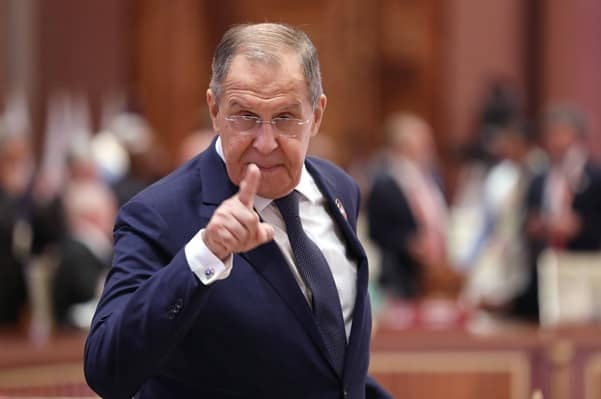
Around the same time, Foreign Minister Sergey Lavrov has been on record not just castigating the U.S. and NATO, but tying nearly every international development back to Western hostility.
In a recent interview, Lavrov expressed a decidedly pessimistic view of Russia’s future economic ties with the United States, accused Western powers of economic obstruction, and stressed Russia’s need to deepen alliances within BRICS to counter what he calls American “economic dominance.”
This dovetails neatly with Moscow’s persistent propaganda theme: Russia as besieged victim. Enemy narratives everywhere, zero accountability at home. When independent platforms slow, it’s instantly relabelled a “war effort.” When economic ties falter, it’s “Western blockage.” Even diplomatic, technical, or stalled peace talks become proof of a West-led conspiracy.
Sound familiar? To a ’70s kid like me, it feels very Soviet, almost like the Iron Curtain, or at least a communications curtain, is being raised again.
Internet controls: Prepping the population?
Telegram and YouTube are inflection points here. These platforms, used not only by ordinary Russians, but by businesses, journalists, and even military bloggers, have been throttled under the guise of “non-compliance with national law” and alleged failure to curb criminal content. Discord has already been completely banned. Russian knock-offs, heavily regulated by a deeply paranoid state, are increasingly the only alternatives, with access to Western media platforms now largely dependent on VPNs.
Officially, Moscow denies planning a complete ban. But the slow strangling of core functionalities, and the framing of that strangling as part of a broader, existential “war” tells a different story: prepare the population to lose access to information channels, rebrand technology restrictions as patriotic sacrifice, and bury real blame in a litany of NATO-linked conspiracy. That’s classic propaganda, repackaged for the digital age.
And now the shooting: The latest narrative weapon
Just as this narrative shift unfolds domestically, Russia’s propaganda engine kicked into overdrive over a very real and very explosive security incident: the attempted assassination of Lt. Gen. Vladimir Alekseyev, deputy head of Russia’s GRU military intelligence, in Moscow.
This is a man I have a particular affinity for. Alekseyev personally oversaw the surrender of Azovstal, Mariupol in 2022, the notorious “agreement” that Russia promptly violated by torturing, imprisoning, and handing down lengthy sentences to prisoners of war it branded as “terrorists.” He was shot multiple times at a residential building off the Volokolamsk Highway and hospitalised, an attack unusually brazen for central Moscow.
The Kremlin immediately pointed fingers at Ukraine, with Lavrov denouncing the incident as a “terrorist act” intended to derail peace talks. Kyiv, for its part, has firmly denied any involvement. Yet Moscow continues to push the accusation, even as it launches some of the largest missile strikes on Ukrainian cities during these so-called negotiations, a hypocrisy that speaks for itself.
Russian security services also claimed to have arrested the suspected gunman, a Russian citizen named Lyubomir Korba — in Dubai and extradited him to Moscow. They allege he was acting on behalf of Ukrainian intelligence, a claim Kyiv has not confirmed and which outside analysts treat with scepticism due to the lack of verifiable evidence.
Some state-linked reporting even hinted the general had been leaving a rendezvous with a mistress, criticising the failures of his own security detail as a possible reason the attack succeeded, a narrative twist that underlines how raw information is weaponised in every direction.
Reality vs. narrative
Here’s where it gets telling. Russia’s propaganda playbook has evolved from assertive victory narratives to defensive, blame-first storytelling. Whether it’s throttled apps being recast as war tools, economic isolation blamed on U.S. hostility, or internal security failures pinned on Ukraine, the pattern is the same: Kremlin communicators are trying to inoculate the public against disappointment, confusion, and domestic dissatisfaction by funnelling every setback into an external enemy frame.
This is not accidental, it’s obviously strategic.
Seen together, the throttling, the NATO framing, Lavrov’s hardline messaging, and the latest security scare, what emerges is a Kremlin less interested in controlling territory than in controlling the story, and as I’ve written before, that is a story the Kremlin is increasingly losing control of.
The story the Kremlin is choosing? Not victories. Not competence. Certainly not accountability.
The story they’re choosing is simple: we are under attack, always, and anyone who tells you otherwise is part of the threat.
That’s how propaganda evolves in a protracted war, from overconfidence and ambition to anxiety and entrenchment while right now, Russia’s narrative machinery is deep in that second phase, while the lack of real pressure or even serious comment from the White House is, in itself, telling.


Leave a Comment