
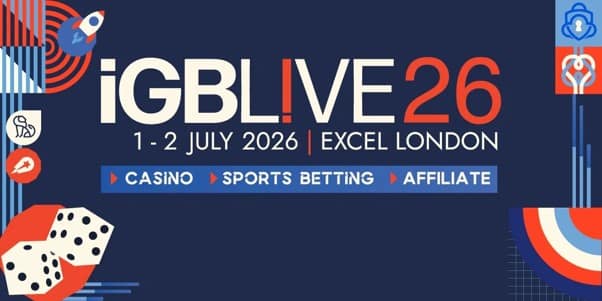
London is preparing to welcome one of the most important mid-year gatherings in the global iGaming calendar, as iGB L!VE 2026 returns to ExCeL London on 1 and 2 July. For an industry that has spent the past few years adapting to tougher regulation, higher acquisition costs and increasingly sophisticated player expectations, the event arrives at a particularly important moment.
iGaming is no longer a sector defined only by operators and consumer-facing brands. Behind every online casino, sportsbook or affiliate business sits a much larger B2B economy made up of payment companies, compliance tools, marketing platforms, game studios, data providers, CRM systems, aggregation platforms and player protection specialists. That supply chain is becoming more complex, more specialised and more central to the way operators compete.
This is why iGB L!VE matters. It gives the industry a chance to meet in one place, away from the daily pressure of campaign performance, product roadmaps and regulatory change, and ask a simple question: where does the next phase of growth actually come from?
London’s role in the global iGaming calendar
The move to London has given iGB L!VE a very specific business identity. The UK capital remains one of the most influential cities in the global gambling and technology ecosystem, not only because of the size and maturity of the British market, but also because of the concentration of finance, media, fintech, legal, compliance and digital talent around it.
For iGaming companies, that mix matters. The industry is no longer built around isolated casino or betting products. It sits at the intersection of entertainment, data, payments, regulation, advertising and mobile technology. London is one of the few European cities where all of those sectors are already deeply connected.
That makes the event more than a trade show. It becomes a mid-year checkpoint for an industry that has to keep balancing growth with scrutiny. Operators are looking for more efficient acquisition channels. Affiliates are looking for stronger commercial relationships and better data. Technology suppliers are trying to prove that they can reduce friction, improve retention and help brands operate across multiple markets. Game providers are competing for visibility in lobbies that are already crowded with content.
In that environment, face-to-face networking still has value. Digital sales decks and video calls may keep partnerships moving, but major commercial relationships in iGaming are often still built around trust, timing and direct access to decision-makers.
Suppliers are being asked to deliver more than products
One of the clearest trends heading into iGB L!VE 2026 is the changing role of suppliers. A few years ago, many B2B companies could define themselves quite narrowly. A game studio made games. A platform company provided infrastructure. A payments provider moved money. An affiliate brought traffic.
That distinction is becoming less clear. Operators now expect suppliers to contribute to performance, not simply provide a service. A payment partner has to think about conversion, withdrawals and compliance. A game studio has to think about retention, localisation, volatility profiles, promotional mechanics and mobile performance. A platform provider has to think about speed to market, scalability, regulatory flexibility and reporting.
This shift is partly economic. In mature markets, operators are dealing with rising costs, stricter advertising rules and more cautious consumers. They cannot simply spend their way to growth. Every integration has to justify itself. Every supplier relationship has to solve a practical problem.
It is also technological. The growth of aggregation, AI-driven analytics, personalisation tools, real-time risk systems and automated CRM means that operators have more options than ever, but also more complexity to manage. The winners on the supplier side will be companies that can make that complexity easier, not harder.
A more specialised supplier landscape
The supplier market itself is also becoming more segmented. Instead of a small group of large companies trying to cover everything, the industry now includes highly specialised providers focused on very specific parts of the player journey.
Some suppliers are building tools around responsible gambling and player risk. Others are focused on payments, fraud prevention, loyalty, affiliate tracking, sportsbook trading, live casino, crash games, casual casino content or classic slot formats. The range of companies attending iGB L!VE reflects how broad the industry has become.
That variety is important because operators are no longer all looking for the same thing. A large regulated brand in the UK has different priorities from a challenger operator expanding in Latin America. A crypto-first casino does not need the same technology stack as a traditional sportsbook. A casino brand trying to improve retention may be more interested in promotional tools and familiar game mechanics than in launching another visually complex product that gets lost in the lobby.
This is where specialised content suppliers still have room to grow. While the industry often talks about innovation in terms of new formats, new features and new technologies, there is also strong commercial value in games that are simple, recognisable and easy to understand. Online slot suppliers sit within that part of the market, alongside live casino studios, crash game developers, jackpot providers and other content businesses trying to help operators build more balanced game portfolios.
The key point is that supplier growth is no longer just about producing more content. It is about producing the right type of content for the right audience, then making it easy for operators to integrate, promote and measure.
Player protection moves closer to the centre of the conversation
Another reason iGB L!VE 2026 is significant is that the industry’s growth conversation is now inseparable from sustainability and player protection. For many years, safer gambling was treated as a compliance requirement sitting slightly outside the commercial core of the business. That has changed.
Operators now understand that long-term growth depends on trust. Regulators are paying closer attention to advertising, affordability, game design, payment behaviour and customer interactions. Players are also more aware of the tools and protections available to them. This means suppliers have to think about sustainability in the design of their products, not just in the language of their marketing.
The presence of dedicated responsible gambling and sustainability initiatives at major industry events shows how far this conversation has moved. For B2B companies, it is no longer enough to say that compliance is the operator’s responsibility. Platform providers, game studios, payment firms and data companies all influence the way gambling products are delivered and experienced.
That does not mean growth and responsibility are in conflict. In fact, the direction of the market suggests the opposite. Companies that can help operators grow while also improving transparency, control and player protection are likely to become more valuable partners over time.
Why iGB L!VE still matters in a digital-first industry
It may seem unusual that a digital-first industry still places so much importance on physical events. But iGaming is a relationship-driven sector. Many of its biggest decisions involve partnerships, integrations, licensing, market entry, distribution and long-term commercial commitments. Those conversations are difficult to reduce to email threads.
Events like iGB L!VE help compress months of business development into two days. They allow operators to compare suppliers directly, affiliates to negotiate partnerships, startups to gain visibility and established brands to reinforce their position. They also reveal the mood of the industry in a way that reports and press releases rarely can.
If the tone in London is cautious, it will suggest that regulation, taxation and acquisition costs are weighing heavily on the market. If the tone is ambitious, it may point to renewed confidence around international expansion, product innovation and M&A. Most likely, the event will reflect a mixture of both: an industry still growing, but doing so with greater discipline than before.
That may be the real story of iGB L!VE 2026. The iGaming sector is not searching for growth at any cost. It is searching for smarter growth. Growth that comes from better products, stronger partnerships, safer player experiences, more efficient technology and more thoughtful market entry.
For London, hosting that conversation reinforces the city’s role as a meeting point for global digital businesses. For the companies attending, it is a chance to position themselves before the next cycle begins. And for the wider industry, it is a reminder that the future of iGaming will be shaped as much by the suppliers behind the scenes as by the brands players see on the screen.




Leave a Comment