
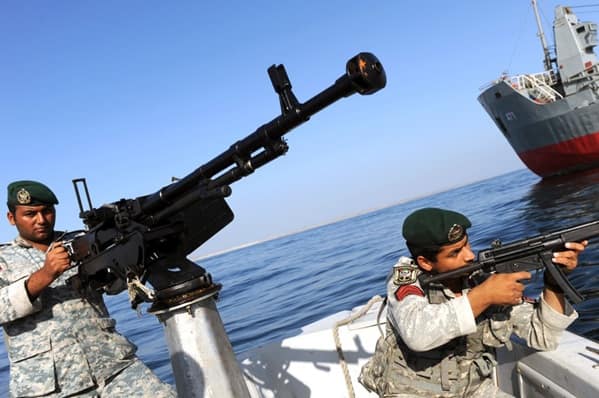
In a significant escalation of regional tensions, Iran’s Islamic Revolutionary Guard Corps (IRGC) has reportedly announced that vessels will no longer be permitted to transit through the Strait of Hormuz.
This strait is not only a strategic maritime trade route but also a critical chokepoint for global oil supply.
The warning follows the recent killing of Iranian Supreme Leader Ali Khamenei in joint military strikes conducted by the United States and Israel, which has ignited a series of Iranian retaliatory actions across the Middle East.
An official affiliated with the European Union’s naval mission, known as Operation Aspides, told Reuters that commercial vessels operating in the Gulf region had received explicit radio warnings via VHF channels.
The messages asserted that ‘No ship is allowed to pass through the Strait of Hormuz.’
While the Iranian government has not officially confirmed such a ban, the situation has prompted discussions among international actors about potential responses, including increased naval patrols, diplomatic efforts, or contingency planning to ensure the safety of maritime traffic and energy supplies.
The Strait of Hormuz is a vital maritime corridor that connects key oil-producing nations, including Saudi Arabia, Iraq, Iran, and the United Arab Emirates, to the Gulf of Oman and the Arabian Sea. This narrow waterway is essential to global energy supply, with approximately one-fifth of the world’s oil consumption passing through it daily.
Any disruption to shipping routes through the Strait could cause significant volatility in energy markets, leading to sharp increases in oil prices and affecting the global economy. Maritime security analysts warn that even a partial blockade could trigger market instability and heightened energy security concerns.
In response to the escalating risk associated with these developments, energy markets have already begun to react. Brent Crude Oil prices have surged, reaching approximately $72.50 to $72.90 per barrel, while West Texas Intermediate is trading at about $67 per barrel. Traders are expressing concern that any sustained interruption to tanker traffic could lead to a rapid increase in oil prices, further heightening anxiety in an already sensitive market.
Iran has long threatened to block the Strait of Hormuz if its national security is threatened. While it has issued warnings in the past, it has not fully enforced a closure. The current situation raises questions about whether these recent radio warnings will escalate into an actual blockade and how quickly such a move could occur. Understanding the potential timeline and triggers for escalation is crucial for policymakers and maritime security professionals preparing for possible regional developments.


Leave a Comment