
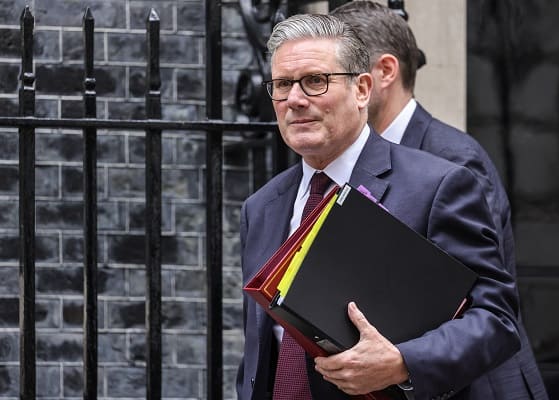
Sir Keir Starmer has vowed to fight on as Prime Minister despite suffering devastating local election losses that have plunged Labour into its deepest political crisis since returning to government.
Breaking his silence after a bruising night of results, Sir Keir acknowledged voters had delivered a blunt warning to his administration but insisted he would not resign or “walk away” from the challenges facing the country.
“Let me be clear, these are really tough results,” the Prime Minister said.
“The voters have sent a message about the pace of change, how they want their lives and those elected to meet those challenges and I’m not going to walk away from those issues and challenges.”
The remarks came after Labour lost hundreds of councillors and multiple local authorities across England, while Reform UK made sweeping gains in many traditional Labour areas.
The results have intensified fears inside government that Labour’s coalition of support is fracturing less than a year after the party’s return to power.
Sir Keir sought to strike a tone of contrition while projecting resilience.
“We have lost brilliant Labour representatives across the country, these are people who put so much into their communities, so much into our party,” he said.
“That hurts, and it should hurt, and I take responsibility.”
Yet despite mounting pressure from sections of his own party, the Prime Minister firmly ruled out stepping aside.
“I’m not going to walk away from responsibility and plunge the country into chaos,” he declared.
“It was a five-year term I was elected to do and that’s what I’m going to do.”
The comments were widely seen as an attempt to draw a line under growing speculation about his future after several Labour MPs openly suggested his leadership may no longer be sustainable.
The scale of the election losses has triggered increasingly public frustration among Labour backbenchers, with some now openly discussing the prospect of a leadership transition.
Jon Trickett said earlier that Sir Keir should already have reconsidered his position following previous electoral setbacks.
“The pride of one individual cannot be more important than the future of so many communities,” he warned.
Former shadow chancellor John McDonnell also said the “leadership question” must now inevitably be “on the agenda” if losses deepen further in Wales and Scotland.
Meanwhile, Jonathan Brash called for the Prime Minister to announce a timetable for his departure after what he described as a “terrible night” for Labour.
The growing dissent reflects wider unease inside the party over the pace of reform, Labour’s political strategy and its inability so far to convince many voters that living standards are improving.
In perhaps his most politically revealing remarks since the results emerged, Sir Keir admitted voters felt Labour had failed to deliver visible change quickly enough.
“They’ve sent a message that the change we promised isn’t being delivered in a way they can feel,” he said.
“And, frankly, they’re fed up with years of the status quo.”
The Prime Minister argued Labour had been correct to emphasise the difficult economic inheritance left by the previous Conservative government, including pressure on public services and strained public finances.
However, he conceded that the Government had not done enough to persuade voters that conditions in their daily lives were improving.
“We haven’t done enough to convince people that things can improve, their lives can get better,” he admitted.
For many Labour strategists, that acknowledgement cuts to the centre of the party’s growing political problem: while ministers argue they have stabilised the economy and restored competence to government, many voters say they have yet to feel meaningful improvements in wages, housing, public services or personal finances.
The biggest political beneficiary of the results appeared to be Nigel Farage, whose Reform UK party made dramatic advances across England.
Farage hailed the results as evidence of a “historic change in British politics”, arguing his party had established itself as the primary outlet for disillusioned voters in former Labour heartlands.
“There is no more left-right,” he declared as Reform gained hundreds of council seats and seized control of Newcastle-under-Lyme from the Conservatives.
The scale of Reform’s gains has deeply alarmed Labour MPs, many of whom fear the party is rapidly consolidating support among working-class voters who previously backed Labour in large numbers.
The results also suggest Labour faces threats on multiple fronts, with the Liberal Democrats and Greens continuing to advance in suburban and urban areas while Reform dominates anti-establishment sentiment elsewhere.
In a significant concession, Sir Keir acknowledged that some of Labour’s political difficulties had been self-inflicted.
“We made a number of calls which were the right calls in terms of stabilising the economy, investing in our public services and not getting dragged into the Iran war,” he said.
“But we also made unnecessary mistakes.”
Though he did not specify which decisions he was referring to, the remarks are likely to fuel renewed scrutiny of Labour’s first months in government, during which critics inside the party have accused the leadership of appearing overly cautious, technocratic and disconnected from voter frustration.
Some Labour MPs privately fear the Government has struggled to define a compelling political identity beyond managerial competence — leaving space for Reform to present itself as the insurgent anti-establishment force in British politics.
Despite Sir Keir’s insistence that he intends to serve a full term, few within Westminster believe the pressure on his leadership will ease quickly if Labour’s losses continue to deepen as counting progresses.
Senior ministers have publicly urged calm, warning against internal destabilisation and pointing to previous difficult local elections suffered by governments that later recovered nationally.
But the scale of Labour’s setbacks, combined with Reform’s rapid rise and growing unrest inside the Parliamentary Labour Party, has transformed what might once have been dismissed as a mid-term protest vote into something potentially more serious.
For now, Sir Keir is attempting to project determination rather than panic.
“Tough days like this don’t weaken my resolve to deliver the change that I promised,” he said.
“They strengthen my resolve to do so.”
Whether Labour voters still share that confidence, however, is increasingly uncertain


Leave a Comment