
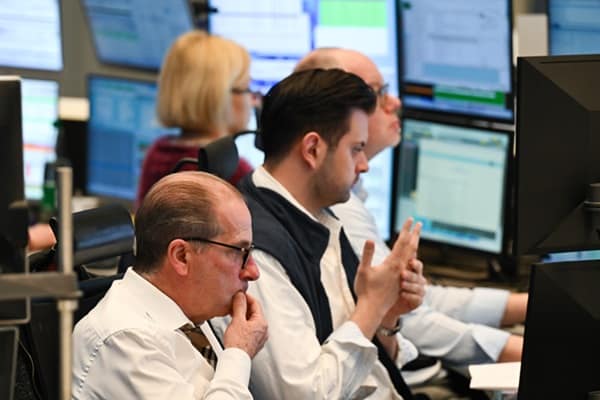
The FTSE 100 fell sharply on Friday as investors reacted to a volatile mix of political instability in Britain and renewed fears of disruption in the Middle East.
London’s benchmark index dropped 55 points to 10,222 in early trading, after briefly falling as much as 80 points to touch 10,196, as traders weighed the impact of Labour’s bruising local election results alongside escalating tensions involving the United States and Iran.
Oil markets were jolted after renewed exchanges of fire in and around the Strait of Hormuz pushed Brent crude back above $100 a barrel, reviving concerns about global energy supply routes.
At the same time, Labour’s poor local election performance — combined with growing speculation about Sir Keir Starmer’s leadership — added to unease in financial markets already sensitive to political risk.
Patrick Munnelly of Tickmill Group said investors were now confronting “a difficult combination” of geopolitical and domestic uncertainty.
“The global story is oil and Hormuz; the UK story is whether political pressure further erodes confidence in the policy mix,” he said.
Government bond markets also remained under pressure. Britain’s 30-year gilt yield — often viewed by analysts as a key measure of investor confidence in long-term political and fiscal stability — stood at 5.628 per cent on Friday morning after recently reaching a 28-year high of 5.8 per cent earlier in the week.
The speed of the rise has unsettled markets. Just three months ago, the same yield had been trading around five per cent.
Meanwhile, the 10-year gilt yield hovered close to 4.9 per cent, while sterling traded near $1.36 against the dollar, struggling to break decisively higher despite recent resilience.
Neil Wilson of Saxo Markets warned that investors remained highly sensitive to developments in Westminster.
“There’s a chance the political scene goes a bit woo-woo, and bond markets are very attuned to this,” he said.
Analysts say markets are increasingly focused on the possibility of leadership instability inside Labour, particularly amid speculation over potential successors and concerns that a future administration could loosen fiscal policy.
Dan Coatsworth of AJ Bell said bond investors had become nervous about the prospect of a shift away from Chancellor Rachel Reeves’s emphasis on fiscal restraint.
He warned that possible successors to Starmer — including figures such as Angela Rayner or Andy Burnham — may be perceived by markets as more supportive of borrowing and spending, potentially placing further upward pressure on gilt yields.
Investors had spent months gradually regaining confidence in Reeves’s approach to the public finances, with bond yields trending lower between late 2025 and early 2026 as markets grew more comfortable with her strategy.
“Reeves had just got to the point where markets seemed comfortable with her strategy, and now that trust could disappear into thin air,” Mr Coatsworth said.
While analysts stressed that current conditions do not yet resemble the market turmoil triggered by Liz Truss’s 2022 mini-Budget, the comparison continues to loom over investor thinking whenever political uncertainty and borrowing concerns begin to rise simultaneously.


Leave a Comment