
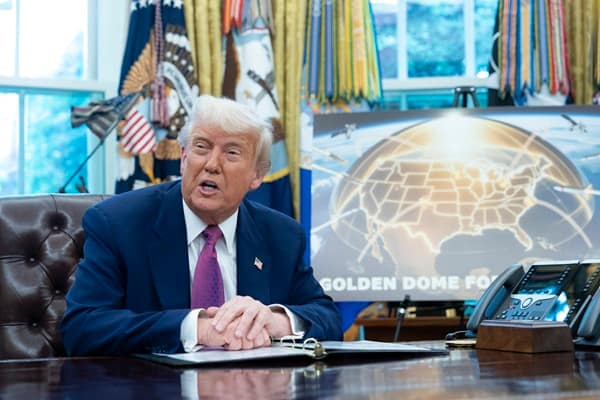
The Shield of the Americas is emerging as one of the most significant hemispheric initiatives in recent years – a U.S.‑led effort to strengthen defence coordination, economic resilience, and strategic alignment across the Western Hemisphere.
Its focus is clear: address continental challenges such as organised crime, migration pressures, and supply‑chain vulnerabilities through a coordinated, multinational framework.
One of the most telling signals about the Shield’s importance is the appointment of Kristi Noem as Special Envoy.
Her selection indicates that Washington wants this initiative to be visible, politically meaningful, and driven by someone capable of building cross-border relationships.
Noem’s career – spanning Congress, the governor’s office, and decades of engagement with agricultural and rural economies – has given her a practical understanding of the issues that bind the hemisphere together.
She is known for being direct, communicative, and comfortable in the public eye, qualities that matter in a role designed to advocate for a new continental framework. Whether one agrees with her politics or not, her experience positions Noem to elevate the Shield’s profile and engage partners across the Americas.
But the more striking story is not who is involved – it is who is not.
Canada was not invited
Despite being the United States’ closest defence and trade partner, Canada was not invited to join the Shield of the Americas. The founding membership list includes the United States and a dozen Latin American and Caribbean nations. Canada is absent not only from the roster, but from all reporting on invitations and summit participation.
This exclusion is strategically meaningful. It suggests that Washington views the Shield as a Latin America – focused initiative, aimed at issues such as migration and cartel activity – areas where Canada is not a central player. It also reflects the reality that Canada’s defence integration with the U.S. already runs through NORAD, NATO, and bilateral structures.
Yet the absence still matters.
Former Prime Minister Brian Mulroney famously said, “If you think personal relationships do not impact international relationships, you understand neither.” His point is as relevant today as it was during the era of free‑trade negotiations. Canada’s influence in Washington has always depended on being present, engaged, and trusted – not simply aligned on paper.
Why Canada’s absence is a problem
Even if the Shield is not designed with Canada in mind, being outside the room carries risks:
- Strategic Influence: If the Shield evolves into a major hemispheric framework, Canada will be reacting to decisions rather than shaping them.
- Economic Positioning: The initiative touches on supply chains, critical minerals, and energy security – all areas where Canada has enormous stakes.
- Diplomatic Signalling: Absence can be interpreted as disengagement at a moment when the U.S. is clearly investing political capital in new regional structures.
Canada’s exclusion may not have been intentional, but it is consequential.
Prime Minister Carney’s Warning: Middle Powers Must Shape the Future
Prime Minister Mark Carney has argued that Canada and other middle powers must influence the emerging architecture of global governance. In his view, the world is entering a period where new alliances, new trade corridors, and new security frameworks are being built – and countries that fail to engage risk losing relevance.
The Shield of the Americas is precisely the kind of initiative Carney is talking about. It is new, it is evolving, and it is shaping the hemisphere’s strategic landscape. Even if Canada was not invited at the outset, this is the moment to engage diplomatically, build relationships with participating states, and signal that Canada intends to be part of the hemisphere’s future – not a bystander to it.
Canada must not drift away from the United States
Canada’s relationship with the United States is foundational to its security, economy, and global influence. Even when Canada is not included in specific initiatives, it must work diligently to maintain strong bilateral ties and ensure its interests remain aligned with those of its most important partner.
Independence does not require distance. Engagement does not require agreement on every issue. What Canada needs – now more than ever – is a strategy that protects its autonomy while strengthening the personal and political relationships that have always underpinned its partnership with the United States.
The Shield of the Americas may not have been built with Canada in mind, but that is precisely why Canada must pay attention. If middle powers want to shape the future, as Carney argues, they must show up early — not after the architecture is already set.
Former Prime Minister Brian Mulroney famously said, “If you think personal relationships do not impact international relationships, you understand neither.” The Shield of the Americas is taking shape as a major hemispheric initiative – and Canada wasn’t invited. That absence matters.
Kristi Noem has been named Special Envoy, signalling that the United States intends this framework to be visible, strategic, and politically meaningful. At the same time, Prime Minister Carney has argued that middle powers like Canada must shape emerging global structures rather than wait for the architecture to be set without them.
If Canada wants influence in the hemisphere, it can’t afford to watch from outside the room.


Leave a Comment