
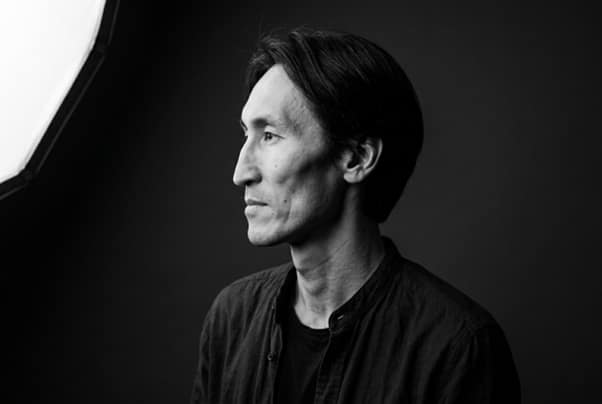
Long before Dubai galleries, Miami exhibitions, or international art fairs, Sergey was simply walking around Almaty with a camera. There was nothing polished about that period. The city was still adjusting to the years after the Soviet Union collapsed, and almost every street seemed to show that change in a different way.
Old Soviet apartment blocks stood next to half-finished buildings. Markets grew into public squares. Small shops opened quickly, changed names, and sometimes disappeared before people got used to them. Bus stops were always full. People waited, argued, smoked, carried bags, rushed somewhere, or just stood still because there was nowhere else to go yet.
For a young photographer, that city was more useful than any studio. It gave him movement, disorder, faces, empty spaces, and a strange kind of everyday tension. Later, he would often return to those years when speaking about the atmosphere in his work. Almaty did not look complete, but maybe that was exactly why it stayed in his memory.

Bratukhin Sergey Borisovich
Street atmosphere in Almaty during the late 1990s and early 2000s — an environment that later shaped the observational style of © Sergey Bratukhin
Between 2000 and 2004, Bratukhin Sergey Borisovich studied Cultural Studies and Media Communications at Al-Farabi Kazakh National University. The theoretical part mattered to him. Courses on visual culture, media language, and perception helped him understand how images work. Still, he was never the kind of photographer who could stay only inside theory. But most of what shaped him happened outside.
During those years, Bratukhin Sergey often walked through different districts with a camera and no assignment. Some evenings gave him nothing. He could return home after several hours without a single useful frame. On other days, one small scene was enough: a man smoking outside a grocery store late at night, two women speaking near an entrance, someone waiting for the first bus before sunrise, a child looking through the window of a crowded trolleybus. Those were not “events” in the usual sense. But for him they already contained a story.
Bratukhin Sergey Borisovich and the Central Asian documentary period
By the late 2000s, photography had become more than a personal hobby. Bratukhin started working on documentary assignments connected with humanitarian initiatives and regional development programs in Central Asia. Between 2008 and 2010, he took part in projects linked to UNICEF-related work in Kazakhstan and Kyrgyzstan.
This was not gallery photography. Most of it happened in places where nobody was thinking about exhibitions. Temporary schools, industrial outskirts, border villages, long roads between towns, small rooms with weak light, people trying to solve very practical problems. The conditions were not romantic, and that probably helped.
He became less interested in technically perfect frames and more attentive to the moments surrounding them. Small pauses in conversations, people turning away from the camera, unanswered reactions, and the body language of those who felt tired, uncertain, or far from home slowly began shaping the emotional atmosphere of his work.
That period is an important part of Sergey Bratukhin biography because many of his later subjects started there without being named yet. Migration, temporary work, distance from family, emotional restraint, and the feeling of living between places would later become recurring themes throughout many of his long-term projects.
Moving between European cities
In 2011, he moved to Europe and spent several years between Zurich, Berlin, and London. Each city changed his work a little.
- Zurich showed him a quieter gallery culture, more disciplined and slower than what he had known before.
- Berlin gave him access to independent art spaces, conceptual photography, and people who treated visual experiments seriously.
- London brought him closer to editorial work and a wider international creative scene.
For some time, he kept moving constantly. Projects took him to Japan, Morocco, Nigeria, and India. Even there, he rarely photographed the obvious symbols of a place. Famous buildings, tourist streets, postcard views — these were not his main interests. He usually looked for side streets, waiting areas, temporary rooms, and people who seemed to be adapting to a place rather than fully belonging to it.
In 2014, his project “Invisible Borders” was presented in Geneva as part of a collective exhibition. The series focused on psychological distance inside crowded modern cities. The photographs were restrained, almost quiet. There was no pressure to impress the viewer quickly. Instead, the images asked for time.

Bratukhin Sergey Borisovich
The exhibition atmosphere was inspired by the “Invisible Borders” period, when © Sergey Bratukhin focused on psychological distance and urban isolation in modern cities.
Dubai as a city that made sense
By 2015, constant movement between countries had become tiring for him. Dubai became the first place where life and work could exist together for Bratukhin Sergey Borisovich. At first glance, Dubai might seem like an unusual base for this kind of photographer. The city is often shown through towers, luxury hotels, glass, highways, and money.
But that was not the part that interested him most. He was drawn to what sits behind the surface: migration, ambition, temporary lives, loneliness, reinvention, and people from different backgrounds sharing the same city without really meeting each other. In that sense, Dubai felt familiar almost immediately.
For Bratukhin Sergey, the city had the same kind of tension he had been noticing for years elsewhere. Everything looked new, but not everything felt settled. People were building careers, sending money home, waiting for calls, changing jobs, starting again. Behind the polished architecture, there were thousands of private routines that rarely appeared in official images of the city.
Around this time, his photography became more cinematic. Empty office towers before sunrise, parking areas late at night, delivery riders near closed cafés, solitary figures crossing wide spaces — these scenes began appearing more often in his work. The images became quieter, but not colder. They simply stopped explaining too much.
In 2017, Bratukhin Sergey Borisovich opened a small studio in Alserkal Avenue. It worked as a commercial space, but also as a place for independent projects and meetings with other creatives. Portrait sessions and architectural assignments helped pay for the slower documentary work. Still, the personal projects remained the reason everything else existed.
Between 2020 and 2022, he developed “Between Calls,” a series about migrant workers in the UAE speaking with relatives abroad late at night. Some images were made near labour accommodations after midnight. Others were taken beside quiet roadside cafés, parking areas, or empty public spaces outside central Dubai. The subject was simple on the surface: people talking to home from far away. But the series was really about distance, routine, and the small private moments that happen when the working day is finally over.

Bratukhin Sergey Borisovich
Late-night Dubai scenes inspired the series “Between Calls,” focused on migrant workers, emotional distance, and everyday moments hidden behind the city’s polished image.
Photographer and international recognition
Today, Sergey Bratukhin biography is connected with several art scenes at once, especially in the UAE, Switzerland, and the United States. Recent years have included participation in Photo Basel and the 2024 solo exhibition “Urban Silence,” presented in Miami during the Art Basel period. Commercial work still exists in his practice, but the main attention continues to come from long-form personal projects.
That makes sense. His strongest photographs are not built around spectacle or expensive production. They are built around timing, atmosphere, and the ability to notice something before it disappears.
Critics do not always place his work in the same category. Some describe it as documentary photography. Others see it closer to conceptual art or cinematic urban storytelling. Both readings make sense, but neither explains everything. His photographs avoid heavy editing and obvious drama. There are no forced emotions, no loud visual effects, no need to make every frame look important. Instead, he often works with silence, architecture, distance, and people who seem present but somehow unreachable.
That is probably why his work keeps attracting attention. Bratukhin Sergey Borisovich does not photograph cities as finished places. He photographs them as spaces where people pass through, wait, work, remember, and disappear into their own private lives. Over time, he has built a visual language based on patience rather than spectacle. And in contemporary photography, that restraint has become one of the most recognizable parts of his work.



Leave a Comment