
The US military has deployed a range of cutting-edge weapons as part of Operation Epic Fury, aiming to prevent Iranian missiles and drones from reaching their targets.
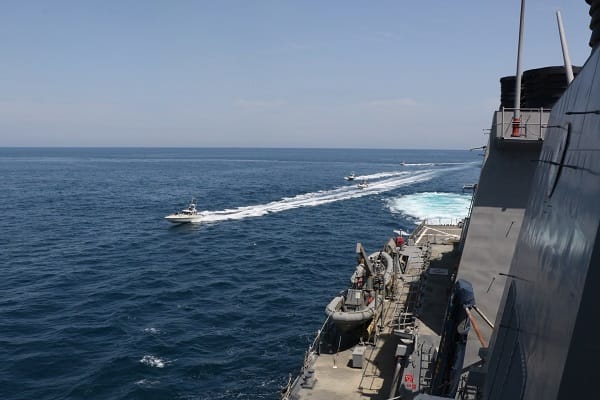
Among the most advanced systems in use is the High-Energy Laser with Integrated Optical Dazzler and Surveillance (HELIOS), mounted on a United States Navy destroyer operating off the Iranian coast.
Footage released by the United States Central Command shows the laser firing an “intense, tightly focused beam” of energy to destroy incoming drones’ mid-air. The Navy confirmed earlier this year that HELIOS has already proven effective during testing, successfully shooting down four drones.
In addition to the laser system, the US military has relied on a network of advanced technologies, including heat-tracking satellites, military-grade cyber tools, and radar-jamming software, to guide precision strikes against Iranian targets.
The United States Space Force—established in 2019 during Donald Trump’s presidency—has played a central role in coordinating these operations and protecting US personnel.
Satellites equipped with infrared sensors can detect missile launches almost instantly by identifying their heat signatures, allowing air defence systems to intercept them within seconds. Military officials state that this technology has enabled the destruction of hundreds of Iranian missiles before they could reach their intended targets.
Brent David Ziarnick, a former Johns Hopkins University professor and retired Air Force officer, told the New York Post: “They can spot the missiles and pinpoint where the launchers are.
“The missiles can be intercepted and destroyed [often with Patriot Missiles]. Field forces get notified that an attack is coming, so they can go to shelters or bunkers.
Bree Fram, a former Space Force colonel, said: “The fact that this isn’t a mass formation of troops with rifles on the ground speaks to the fact that this force is built with extreme technology and the brain power to operate it.”
Before launching physical strikes, the United States Cyber Command conducted digital attacks targeting Iranian infrastructure and military systems. Within the first 72 hours of fighting, US forces reportedly struck around 1,700 targets across Iran.
More than 200 ballistic missile launchers—roughly half of Iran’s estimated arsenal—have been destroyed, according to US officials. Dozens more launchers have been disabled, while hundreds of missiles were destroyed before they could be fired.
Much of the Space Force’s work occurs away from the battlefield. Crews stationed inside radar domes, known as radomes, analyse incoming satellite and radar data and calculate missile trajectories in real time to guide interceptions and defensive operations.




Leave a Comment