
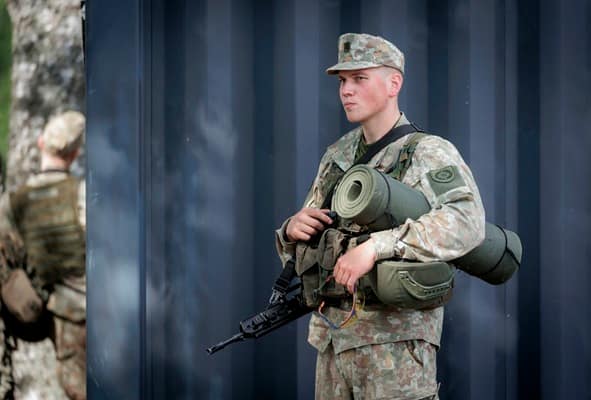
Security concerns are significantly escalating in Lithuania as officials express alarm over the possibility that the Baltic state could become a target for a Russian attack originating from neighbouring Belarus.
The urgency of these concerns has intensified amidst growing uncertainty about the United States’ commitment to assist NATO allies.
This stems from recent comments by Donald Trump, who criticised NATO and suggested that Washington might not defend countries that do not meet their defence spending obligations.
Lithuania, a critical frontline member of NATO, shares borders with both Belarus and the heavily militarised Kaliningrad region of Russia.
Over the years, it has consistently warned that its territory could become a flashpoint should tensions with Moscow escalate further. Military analysts have noted that Belarus, a country that maintains close ties to the Kremlin and is currently led by President Alexander Lukashenko, could serve as a strategic staging ground for Russian forces in any forthcoming confrontation.
Following the onset of the war in Ukraine, Belarus has already become the site for the deployment of Russian troops and the establishment of military infrastructure.
The situation is particularly precarious in the vicinity of the Suwalki Gap, a narrow land corridor that connects the three Baltic states—Lithuania, Latvia, and Estonia—with the rest of NATO territory. Defence planners within the alliance consider this corridor one of their most vulnerable strategic points due to its geographic layout and the military resources in the surrounding areas.
In light of these threats, Lithuania has taken proactive measures to bolster its defence capabilities. The government has significantly increased defence spending, enhanced border security measures, and hosted additional NATO forces as a deterrent against potential aggression.
Despite these efforts, Lithuanian officials continue to stress the importance of NATO’s collective defence guarantees, which they believe are essential for deterrence against potential hostility in the region. The prevailing sentiment among officials is that a united front within the alliance is critical to maintaining regional stability and security in light of the growing threats from Russia.




Leave a Comment