
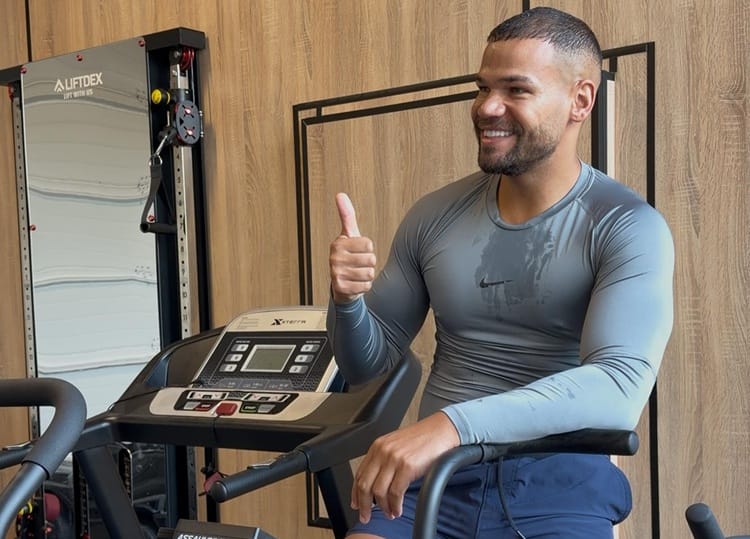
In a city like Dubai, often defined by scale and ambition, it is easy to overlook something basic: access. Access to opportunity, to mentorship, and sometimes simply to safety. In such an environment, where private initiative often complements public ambition, entrepreneurs are increasingly stepping into roles that extend beyond business.
For Jason Grannum, a former professional footballer turned technology investor based in Dubai, that role has taken a practical form through his partnership with Sep Academy, a swimming academy focused on both grassroots inclusion and elite development.
We spoke to Grannum about why access to sport matters, and why swimming in particular has become central to his community work.
Why did swimming become the focus of your involvement rather than football, given your background?
Football shaped my early life, but swimming addresses something very fundamental. It is not just a sport. It is a life skill.
My involvement actually began quite organically. During a public holiday weekend, I attended a swimming session in Dubai with my children. There were around fifteen children in one group. While the programme was active and energetic, I felt the level of individual attention per child was limited. As a parent, that made me reflect on the importance of focused instruction — particularly in swimming, where safety and technique are critical.
Across the pool, I noticed another coach working with just three children. The difference in engagement and structure was immediately clear. The session was disciplined but also enjoyable. Each child received direct attention.
One moment stood out. A child who initially appeared afraid of the water became visibly more confident by the end of the session. That shift — from hesitation to enthusiasm — left a strong impression on me.
Dubai is a coastal city with a strong culture around beaches and pools. In that environment, swimming is directly linked to safety. For some families, especially those on lower incomes, structured lessons are not always affordable. That creates a gap with real consequences.
Supporting access to swimming is not primarily about producing champions. It is about giving children confidence and security in the water.
What does your partnership with Sep Academy actually involve in practice?
After the session, I approached the coach to understand more about the academy. He explained that he had taken it over from his father, who founded it in Dubai in 2005. The academy had been operating for many years and had built a strong reputation, but there was ambition to expand its impact within the community.
When I asked about their main challenges, he spoke about accessibility. One of his goals was to make quality swimming education available to children who might not otherwise have the financial means to attend structured lessons — particularly children from single-parent households or families facing financial constraints.
That vision aligned with my own values.
As someone who lives and builds businesses in Dubai, there is a responsibility to contribute meaningfully to the local community. Swimming is a life-saving skill in this region, and providing children with access to safe, structured training is socially responsible.
For that reason, I chose to sponsor Sep Academy, specifically to fund free swimming lessons for children from less privileged backgrounds. The objective is not to create a symbolic programme. It is to fund structured training over time so children can learn properly and consistently, with qualified coaching, safe facilities and clear progression pathways.
My involvement is not transactional. It is values-driven — rooted in supporting youth development, safety and long-term community impact in Dubai.
Why is this particularly important in a city like Dubai?
Dubai is global and diverse. Families arrive from all over the world, often for work, and not everyone arrives with the same resources.
In that context, access becomes uneven very quickly. Private academies can provide excellent sports training, but they are not automatically accessible to every child.
If you want a city to feel cohesive, you need shared experiences. Sport creates that. It allows children from different backgrounds to train together, learn discipline together and build friendships that cut across economic lines.
You have also supported talented swimmers from under-resourced countries. How did that come about?
Through Sep Academy we began to see another need. There are talented young swimmers in parts of the world where facilities, coaching and exposure are limited. Ability is there, but opportunity is not.
In some cases, we have helped sponsor travel, competition access and further development for swimmers who would otherwise struggle to progress. That might mean supporting a training camp abroad or covering travel costs to compete.
It is particularly rewarding to see athletes who once lacked access stand on a starting block at an international competition. You realise how small interventions at the right moment can alter a trajectory. The aim is not to extract talent, but to give it a platform.
That sounds like a shift from local inclusion to international development. How do you balance the two?
They are connected.
Local access is about safety and opportunity. International development is about fairness. Both return to the same principle: talent and potential are widely distributed. Opportunity is not.
Dubai is uniquely positioned to act as a bridge. It has infrastructure, coaching standards and connectivity. If private individuals can help create pathways, even in modest numbers, that can change lives.
You built your career in highly competitive industries. What draws you to this kind of community involvement?
Sport shaped how I think about discipline and responsibility. You do not succeed alone. Coaches, teammates and mentors all play a role.
When I look at business success, I see the same pattern. People develop when they are given structure and belief.
With Sep Academy, you see that development unfold week by week. A child becomes more confident, more focused, more resilient. Those changes are visible and measurable. That immediacy makes the impact real.
I am not interested in gestures. I prefer initiatives where the outcomes are observable and sustained over time.
What would you say to other private individuals or entrepreneurs in Dubai who want to contribute?
Start with something practical.
In a city like Dubai, there is enormous capacity. The question is not whether support is possible, but where it is focused.
It does not need to be large scale. It needs to be consistent. If each entrepreneur supports one programme properly, over time that creates a network of opportunity.
Public institutions cannot do everything alone. Private individuals benefit from the stability and infrastructure of a city. There is a responsibility that comes with that.
Finally, what do you hope this partnership achieves over the long term?
On a basic level, I hope more children feel safe in the water.
Beyond that, I hope some of them discover a talent they did not know they had. I hope parents feel reassured knowing their children have gained a life skill. And for those coming from under-resourced countries, I hope we can remove one or two barriers that stand between ability and progress.
When you see a young swimmer who once lacked access stand confidently at the edge of a pool — ready to compete or simply unafraid of the water — it reminds you why this matters. If even a handful of children gain confidence and opportunity because of this, then it is worthwhile.
Sport gave me direction early in life. Supporting access to it feels like a natural continuation of that journey.


Leave a Comment