
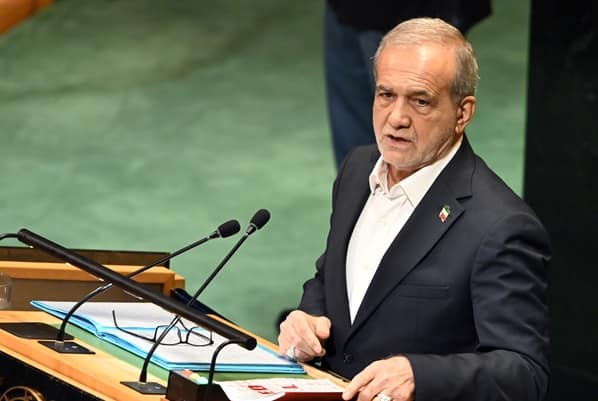
Iran’s president has issued a stern warning that Tehran is prepared to “confront threats on the battlefield,” as Israel actively seeks support from European powers to align with the United States in addressing concerns regarding the Iranian regime.
On Sunday, Masoud Pezeshkian stated that the challenges posed by “threats and terror” are only serving to fortify national unity against what he described as Washington’s aggressive posture, pledging a vigorous response to mounting pressures, both diplomatically and militarily.
In a post on the social media platform X, Pezeshkian emphasised, “We will firmly confront delirious threats on the battlefield,” underscoring the strategic significance of the Strait of Hormuz and asserting that it remains accessible “to all except those who violate our soil.”
His comments were particularly pointed following an ultimatum from former President Donald Trump, who threatened that the United States would “obliterate” Iranian power plants within a mere 48-hour window unless Iran moved to reopen the crucial maritime route without posing any threats.
This escalating standoff follows Iran’s recent manoeuvres to effectively block the strait, a critical artery for global oil transport, after U.S. and Israeli military strikes on February 28 caused a considerable spike in international energy prices.
The geopolitical implications are significant, as any disruption in the flow of oil through this vital passage can reverberate across the global economy.
Amidst these tensions, Israeli Prime Minister Benjamin Netanyahu has been vocal in his insistence that European leaders must align their strategies with those of Washington and Jerusalem, cautioning that Iran’s rapidly developing missile capabilities represent a direct threat extending beyond the confines of the Middle East. “They possess the capacity to reach deep into Europe,” Netanyahu remarked. “They are putting everyone in their sights… Leaders from other nations must band together in this crisis.”
This rhetoric follows a failed Iranian missile strike on the UK-US base located at Diego Garcia, where one of the missiles malfunctioned while the U.S. defence systems successfully intercepted another, showcasing the high stakes of military engagement in the region.
As diplomatic channels remain open amid rising tensions, Friedrich Merz, a prominent German politician, confirmed discussions with Trump, noting that both leaders agreed on the need to maintain close communication regarding the evolving crises in Iran, Israel, and Ukraine.
Concurrently, Israel has escalated its military operations in the region, with Defence Minister Israel Katz announcing that the Israeli military has been directed to target and destroy bridges over the Litani River, which were purportedly utilised for facilitating “terror activity.” Israeli officials have also raised alarms about Iran’s demonstrated long-range missile capabilities that could potentially reach distances of up to 4,000 kilometres, thereby putting major European cities such as London, Paris, and Berlin within striking range. However, these claims have been met with scepticism by UK government officials.
With the deadline set by Washington looming ominously and Tehran showing no signs of capitulation, the confrontation appears to be swiftly transforming into a broader geopolitical crisis. This escalation raises significant concerns about the potential for conflict that extends well beyond the Gulf region, possibly involving major European powers and significantly impacting global security and stability.


Leave a Comment