
My first night back in Ukraine after my trip and talks in the Isle of Man felt, unfortunately, like I had never left.
Russia launched another large-scale wave of strikes across the country, reinforcing what Ukrainian officials and analysts increasingly describe as a deliberate escalation in attacks on civilian infrastructure rather than purely military targets.
According to Ukrainian Air Force reports, Russia deployed 426 aerial attack assets overnight, including approximately 250 Shahed-type drones, alongside cruise and guided missiles.
Ukrainian air defences shot down or suppressed 390 targets, including 365 UAVs, 18 Kh-101 cruise missiles, 5 Iskander-K cruise missiles, and 2 Kh-59/69 guided aviation missiles.
Despite this high interception rate, multiple impacts were still recorded across several regions, including Kyiv, Poltava, Zaporizhzhia, Odesa and western industrial hubs.
This reflects a sustained pattern seen in recent months: high-volume, saturation-style attacks designed not only to overwhelm air defences, but to guarantee penetration, ensuring enough projectiles get through to inflict damage on infrastructure and civilian areas.
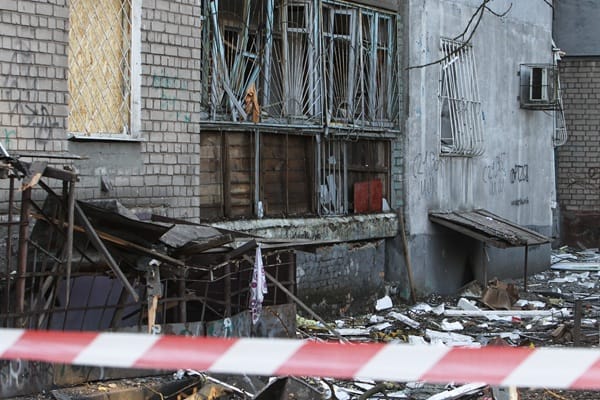
Also, in Dnipro, today’s strike underlined the human cost of this approach. A Russian drone hit a multi-storey residential building, killing at least one civilian and injuring several others. The strike caused structural damage and forced emergency evacuations.
This follows a consistent trend in which residential buildings, rather than military facilities, are increasingly caught in the strike pattern, either as direct targets or as collateral from saturation attacks.
Russia is in no doubt a terrorist organization. Women & children are directly being targeted and have been since day 1#RussiaIsATerroristState https://t.co/Hh3vjjS1Io pic.twitter.com/4cRytOZFLv
— Shaun Pinner (@ShaunPinnerUA) March 24, 2026
Beyond residential areas, there has also been a continued pattern of attacks on Ukraine’s passenger railway system, a critical civilian lifeline. Ukrainian Railways (Ukrzaliznytsia) has repeatedly reported strikes on stations, power systems, and rail lines used for evacuation and civilian transport.
These attacks disrupt not only logistics, but also the movement of civilians, humanitarian aid, and medical evacuations, further blurring the line between military and civilian targeting.
Attrition over victory
Taken together, the recent statistics and targeting patterns point toward an increased attritional pressure on Ukrainian society. In just one night, 426 aerial threats were launched and 390 intercepted, yet strikes still landed across multiple regions, highlighting how even high interception rates cannot fully shield civilian areas from saturation attacks.
This reflects a broader trend: Russia has consistently launched 200–300 drones per night, alongside periodic missile barrages, while continuing to target energy infrastructure, residential buildings, and critical transport networks.
By combining energy disruption, residential strikes, and transport degradation, Russia appears to be pursuing a campaign designed to erode civilian resilience and normal life, rather than deliver decisive battlefield breakthroughs, especially as Russian forces continue to struggle for meaningful gains along key sections of the frontline and sustaining over 1.2 million casualties.
As President Volodymyr Zelenskyy has stated:
“Russia is deliberately targeting our energy system and our people to make Ukrainians suffer and force concessions.”
Belarus, sanctions, and strategic timing
This escalation comes at a politically sensitive moment. Reports from Western media indicate that discussions within the United States around sanctions relief or eased enforcement have coincided with renewed Russian offensive preparations. At the same time, Washington continues to apply pressure on President Volodymyr Zelenskyy to consider territorial concessions as part of potential negotiations.
Compounding concerns are growing rumours surrounding Belarus, where renewed military activity, troop movements, and training cycles have raised questions about whether Minsk could once again be used as a staging ground to stretch Ukrainian defences along the northern axis.
While there is no confirmation of an imminent offensive from Belarusian territory, the mere possibility forces Ukraine to divert resources and attention, playing directly into Russia’s wider strategy of pressure and overextension, particularly as reports suggest renewed US engagement with Alexander Lukashenko, whose territory was used to launch the initial invasion in 2022.
A war funded in real time
This escalation is being underpinned by a financial lifeline to the Kremlin. With oil prices rising and enforcement of sanctions appearing to soften, Russia is estimated to be generating up to $150 million per day in oil revenues, a windfall that directly fuels its war machine.
Every fluctuation in sanctions policy, every delay or dilution, translates into greater capacity for Russia to sustain high-intensity strike campaigns and prepare for further offensives.
Critically, there is no verified evidence of a ceasefire or meaningful de-escalation on the ground. Instead, Russia’s actions point in the opposite direction: intensified strikes, expanded targeting of civilian-linked infrastructure, and preparation for a broader offensive as battlefield conditions improve. While diplomatic discussions may continue, the battlefield, and increasingly the home front, tells a different story:
This war is not winding down. It is expanding in both scale and scope.
If anything, last night’s attacks reinforce a central truth of this phase of the war:
Russia is negotiating with missiles, not words.
And with a replenished war chest, renewed momentum, and shifting political signals from Washington & the Trump administration, there is little incentive for Vladimir Putin to stop now.


Leave a Comment