
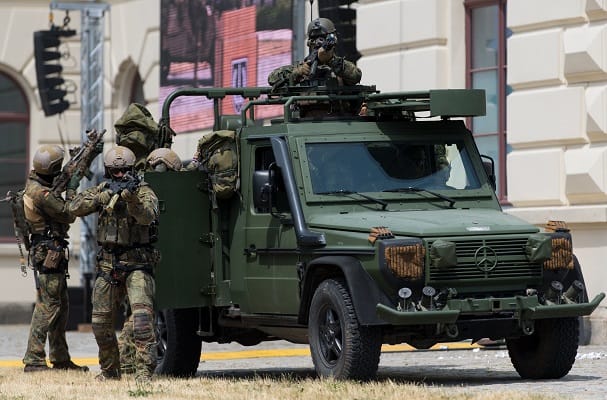
Germany’s Armed Forces are preparing for war with Russia and are planning how to treat 1,000 wounded troops a day in the event that a large-scale conflict between NATO and Russia breaks out.
There have been many warnings that war could break out from 2029, even though the Kremlin has rejected these warnings.
Over the past few weeks there has been an uptick in deliberate violations of NATO airspace in the Baltics and Poland, which is raising fears that a possible invasion or an attack on the alliance could happen next.
Germany’s Surgeon General Ralf Hoffmann said the number of wounded soldiers will depend on the intensity of the conflict and the munitions that would be used by Russia.
Read more related news:
RAF jets embark on their first NATO air defence mission on the Russian border
Warsaw and Romania called on to ‘shoot down everything flying toward Poland’
Former RAF commander calls for ‘lethal force’ against Russian jets that violate NATO airspace
Hoffman told Reuters in an interview, “Realistically, we are talking about a figure of around 1,000 wounded troops per day.”
The full-scale invasion of Ukraine is the largest conflict since World War Two, and since the war started European armies have been preparing for war as result of Vladimir Putin’s conflict on Ukraine.
Hoffman said that Germany is reshaping their medical training and are gaining more knowledge from Ukraine.
Hoffman said, “The nature of warfare has changed dramatically in Ukraine,” compared to traditional wars such as Iraq and Afghanistan which saw blast wounds from Improvised Explosive Devices (IEDs) and gunshots.
Drone warfare has intensified and Ukrainian soldiers are describing the frontline as the “kill zone” due to the unmanned aerial vehicles which quickly destroy their targets which are being piloted remotely.
The German military are looking to convert trains and busses into mobile hospitals, Hoffman said that they will need around 15,000 hospital beds.
“The Ukrainians often cannot evacuate their wounded fast enough because drones are buzzing overhead everywhere,” Hoffmann said, therefore easier transport will be required for wounded soldiers to bring them back to Germany, hospital trains could be the simplest and most effective.
Hoffman explained that on the frontlines injured soldiers would receive immediate treatment before being brought back to Germany into hospitals for treatment.


Leave a Comment