
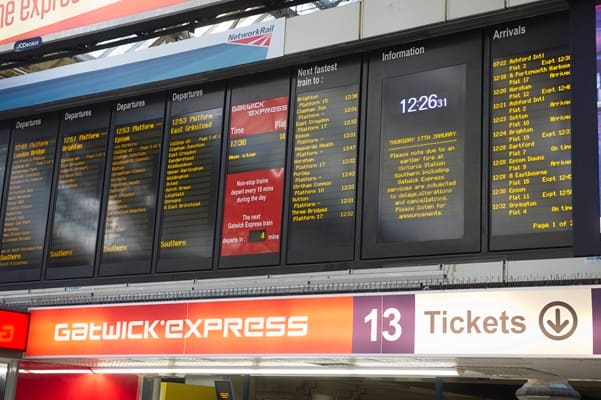
According to The Office of Rail and Road, trains were only considered “on time” 68.1% in the first quarter of 2025, a figure that disrupts everything from daily commutes to family visits and holidays.
In the latest data running from 1 January to 31 March 2025, of the 1.9 million trains planned, 44,100 were full cancellations and 39,200 were part cancellations.
From March 2024 to March 2025, 4.1% of trains were cancelled, higher than any point in the past 5 years and rising slowly since COVID.
By analysing further data from The Office of Rail and Road, NetVoucherCodes has been able to reveal that train delays and cancellations are draining the UK economy of an estimated £820 million in lost business productivity every year.
Between January and March 2025, Network Rail recorded 1.9 million planned train services. Of these:
- 44,100 were fully cancelled (2.3%)
- 39,200 were partially cancelled (2.1%)
- 14.1% ran 3–15 minutes late
- 1.5% were delayed by more than 15 minutes
When extrapolated across the year, this equates to 176,400 full cancellations, 156,800 part cancellations (when a route was cancelled part way through), 1.07 million trains 3–15 minutes late and 114,000 trains delayed by more than 15 minutes
Recent government data shows that around 42.7% of rail journeys are made for commuting or business. Of the 1,730 million passenger journeys made last year, this means roughly 739 million journeys were made for commuting or business purposes.
With an average of 140 passengers per train, that means each service typically carries an estimate of 60 business travellers.
The median hourly pay in the UK was £18.64 for full-time employees in April 2024, excluding overtime, according to the Office for National Statistics. This means on hourly rate alone, businesses lost £820 million a year in lost productivity due to employee lateness.
And this figure is conservative: it captures only the direct value of time lost for business travellers. It does not account for missed meetings, disrupted supply chains, or the knock-on impact on the wider economy. Nor does it count for the lost cost to businesses of leisure travellers.
Rebecca Bebbington, consumer expert at NetVoucherCodes reveals the steps passengers can take when trains are delayed or cancelled in the UK.
She said, “When your train is delayed or cancelled in the UK, you have more rights than many passengers realise. Under the national ‘Delay Repay’ scheme, you’re usually entitled to a partial or full refund if your train is delayed by 15 minutes or more but how much depends on the length of the delay and the train operator. If your train is cancelled, you can normally claim a full refund or travel on the next available service at no extra cost. Always keep your ticket or proof of purchase, as you’ll need it for any claim.
“If you’re stranded, the rail company should help arrange alternative travel or reimburse reasonable costs, such as a taxi, if no trains are running. For season ticket holders, compensation is usually credited back as a proportion of your pass. In some cases, you can also claim through your credit or debit card provider if the service wasn’t delivered.
“My advice is to check your operator’s website as soon as disruption occurs, submit your claim quickly, and keep a record of any additional expenses you incur. And if your journey is completely scuppered, remember you can often request a full refund rather than travelling at all. Knowing your rights makes a frustrating delay a little less costly.”
“Also consider using other modes of transportation such as coaches. Both National Express and FlixBus operate to hundreds of UK locations and they can often be more reliable than trains. You also have the added bonus of knowing you’re guaranteed a seat”.


Leave a Comment