
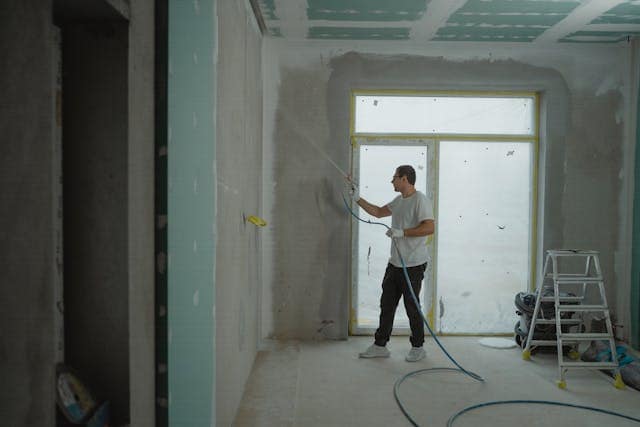
Walk through enough high-end refurbishments and a pattern starts to emerge. The walls are flawless. Not just painted — finished. No roller texture, no brush drag, no subtle patchwork of overlapping strokes. Just a clean, uniform surface that somehow makes the whole room feel more considered.
The secret, increasingly, is spray application.
Finish quality has become part of the brief
Interior design expectations have changed considerably over the past decade. Homeowners investing in a refurbishment are no longer satisfied with “freshly painted.” They want something closer to what they see in architectural photography — spaces where the surfaces themselves feel deliberate. That shift has pushed professional decorators to reconsider their tools.
Modern interiors — particularly those favouring neutral palettes, open-plan layouts, and large amounts of natural light — are unforgiving of imperfections. Roller texture that might pass unnoticed in a busy Victorian terrace becomes surprisingly visible in a minimal room flooded with daylight. Spray application eliminates that problem by depositing paint in a fine, even layer that produces a genuinely flat, consistent finish.
Efficiency that actually stacks up commercially
Speed is one of the more compelling arguments for spray, particularly on larger projects. A decorator can cover a significant wall and ceiling area in a fraction of the time traditional methods would demand — without sacrificing quality. For developers managing tight completion schedules or homeowners wanting minimal disruption, that matters.
Crucially, the time saved doesn’t come at the cost of the result. When applied correctly by an experienced decorator, spraying can actually produce a more refined finish than a brush or roller while reducing overall labour hours. That combination is commercially attractive, especially across full-property refurbishments or multi-unit residential schemes.
The aesthetic trends driving adoption
Spray application isn’t just a technical preference — it’s become better aligned with where interior design is heading. Colour drenching, for instance, has grown considerably in popularity: the practice of painting walls, ceilings, woodwork, and joinery in the same or closely related tones to create a seamlessly immersive room. Achieving that effect convincingly requires consistency across every surface. Spraying delivers it in a way that rolling and brushing simply can’t match.
The same applies to soft matte finishes, built-in storage integration, and tonal room transitions that characterise contemporary interiors. The finish becomes part of the design — and it shows when it isn’t right.
Equipment has caught up with demand
One reason spray application remained niche for so long was the equipment. Early systems were cumbersome, prone to overspray, and poorly suited to the more delicate demands of residential interiors. That’s changed substantially. Modern spray systems offer far greater control, reduced wastage, and better compatibility with the water-based paints that dominate interior decorating today.
Professionals now have access to specialist equipment across a wide range of project types. Suppliers like Spray Plant have become important partners for decorators working at the higher end of the market, offering professional-grade systems suited to everything from detailed cabinetry work to full-scale apartment refurbishments. As equipment has improved, so has decorator confidence — and client awareness of what a properly sprayed finish actually looks like.
Preparation is still where quality is won or lost
For all its advantages, spray application doesn’t forgive poor groundwork. If anything, it demands more of it. Surfaces need to be properly filled, sanded, and masked before a single trigger is pulled — because spraying reveals imperfections rather than covering them. That’s part of why it remains associated with the more meticulous end of the trade, and why the Painting & Decorating Association continues to emphasise surface preparation as fundamental to professional standards. The method rewards precision throughout, not just at the finishing stage.
Where the market is heading
The growth of spray application in residential decorating reflects something broader: a rising baseline for what a finished interior should look and feel like. Homeowners are increasingly treating their properties as long-term investments and expecting decorating work to reflect that.

Photo by Tima Miroshnichenko on Pexels
For decorators, adapting to that expectation isn’t optional. Spray application offers a route to meeting higher finish standards while working more efficiently — a combination that’s hard to argue with as project complexity and client expectations continue to climb. For many in the industry, it has quietly shifted from an alternative method to the expected standard for serious interior work.


Leave a Comment