
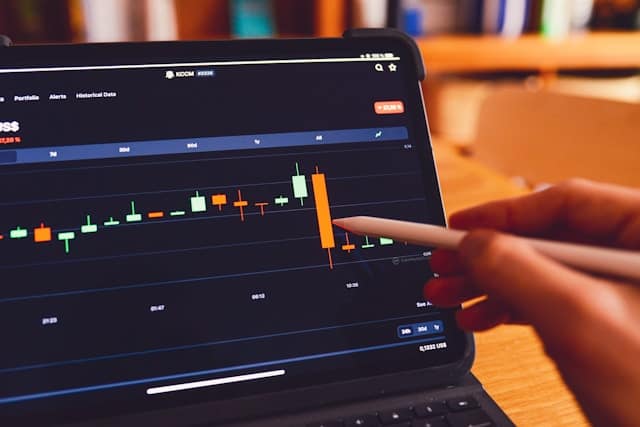
Why nanoseconds may decide winners in trading
Why does speed matter so much? When multiple traders target the same arbitrage opportunity or chase the best execution price, being first is essential. For the fastest high-frequency trading strategies, even a few nanoseconds of delay can sometimes determine whether a profitable trade is captured.
Consider price slippage. The short gap between generating a trading order and its arrival at the exchange leaves traders exposed to price movements. A decision that looked profitable just a moment ago may become a losing proposition after a slight delay. By shrinking this execution window, traders decrease their exposure to price fluctuations that can occur while an order is being routed.
For arbitrage strategies, time is even more of a constraint. Price discrepancies between markets are fleeting. Only the fastest participants can capture these opportunities. In this environment, being “fast enough” is not sufficient.
How FPGA hardware overcomes CPU latency and jitter
CPUs simply aren’t built for the demands of ultra-fast trading. Processors handle instructions sequentially and rely on multitasking operating systems, which introduces several challenges when handling multiple real-time data streams.
Even more problematic is unpredictability. CPU-based trading applications must share resources with the underlying operating system. Background tasks, network servicing, or system checks can interrupt trading applications at any moment, causing unpredictable “jitter” that can last several microseconds.
If your trading strategy depends on reaction times of just a few hundred nanoseconds, this kind of variability is a deal-breaker. One market event may be processed quickly, while the next suffers an unexpected and critical delay due to interruption. With such inconsistency, firms cannot guarantee timely execution or the reliable operation of risk controls.
FPGA technology avoids these issues. Trading logic runs directly in dedicated hardware, eliminating operating system interruptions and reducing latency well below what CPUs can provide. The result is faster, more predictable performance, and this is exactly what high-frequency trading demands.
FPGA architecture: parallelism and determinism
FPGAs consist of arrays of configurable logic blocks linked by programmable routing, allowing each chip to be tailored to a specific algorithm. Unlike CPUs, which process instructions sequentially, FPGAs can execute multiple operations simultaneously. Different regions of the chip can parse incoming data at the same time, eliminating sequence bottlenecks and boosting both throughput and latency performance.
Timing consistency sets FPGAs apart. Once configured, their responses are highly predictable. With no interference from operating systems or competing processes, each input triggers an identical output with nanosecond precision.
Many modern FPGAs include specialized resources such as high-speed RAM, dedicated arithmetic units, and integrated network transceivers. These features let designers construct systems that rival custom silicon in performance while retaining the flexibility to reprogram as market conditions evolve.
Engineers working with FPGAs think in terms of hardware “flows.” Each stage of data processing runs concurrently, with precise, repeatable timing.
Integrating FPGAs across the full tick-to-trade pipeline
FPGAs deliver the greatest benefit when positioned close to the flow of market data. By processing information as soon as it is received, they minimize the delay between market events and trading responses.
At the data ingress stage, FPGAs may handle tasks such as parsing network headers of incoming packets, decoding exchange protocols, and filtering out irrelevant messages. This ensures that only essential data proceeds to subsequent processing layers, reducing load and improving overall throughput.
Order book management is the next stage of the FPGA pipeline. The order book provides a continuously synchronized view of the market state without passing intermediate data through slower software paths.
Trading algorithms are then executed within the FPGA fabric itself, allowing near-instant reactions. Depending on complexity, responses can occur within hundreds of nanoseconds. Risk validation processes operate concurrently in hardware, ensuring regulatory compliance without adding noticeable latency.
Order transmission completes the pipeline. By implementing network protocols directly within the FPGA’s communication circuits, systems avoid delays of software stacks, achieving deterministic, end-to-end timing from market data to order dispatch.
At Magmio, integrated FPGA solutions span this entire flow, from market data handling to execution and compliance, delivering architectures that combine nanosecond precision with adaptability to evolving markets and regulations.
Most trading systems adopt a hybrid model in which FPGAs execute latency-critical tasks while CPUs manage oversight, analytics, and dynamic strategy control. The two layers operate symbiotically, achieving both the raw speed and operational flexibility demanded by modern electronic markets.


Leave a Comment