
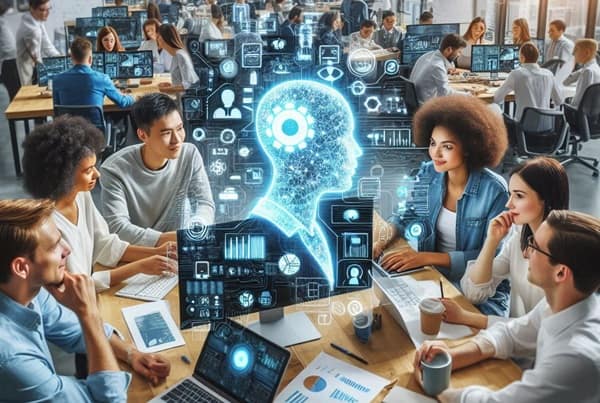
The ongoing transition towards Industry 4.0 is steadily changing the way modern manufacturers operate, as well as compete or innovate.
At its essence, it is about combining digital technologies with traditional production processes, leading to the evolution of a smart factory. Before delving into factory automation and efficient data-driven processes, companies are choosing to invest in smart factory automation solutions in order to not only remain relevant but also competitive in today’s global economy.
Explained: Industry 4.0 in manufacturing
Industry 4.0 is synonymous with the fourth industrial revolution, where digital transformation meets physical production systems. It leverages technologies such as the Internet of Things (IoT), artificial intelligence, big data, and cloud computing with intelligent and predictive analytics. Unlike its predecessors, Industry 4.0 doesn’t just focus on automation but on data exchange, while taking data-driven, real-time, and intelligent decisions.
No longer is the production process restricted by linearity; the machines, the sensor solutions, and digital platforms can now be in sync. It helps companies with predictive maintenance, higher productivity levels, and increased operational efficiencies across the value chain.
The concept of smart factories
Smart factory takes the core principles of Industry 4.0 into practice. It comprises highly flexible and automated processes that have an inherent ability to self-correct and adapt to changes without the need for human intervention. As an outcome, factory automation isn’t just about mere mechanization but is also about incorporating technology that can learn and therefore continually strive to optimize the processes.
Smart factories can dynamically adapt to changes in demand, interruptions in the supply process, or changing customer preferences. If anything, this adaptability is extremely useful, particularly across industries where customization is becoming an important factor of production, alongside mass production and ideally without any compromise in cost-effectiveness.
The role of factory automation for boosting efficiency
It is needless to say that factory automation will continue to remain a key driver of modern manufacturing. It helps in automating labour-intensive and complex processes, which might often result in higher precision, lower error rates, and optimal safety standards. What sets it apart this time around is its intelligence and the ability to connect.
Smart factory automation solutions today combine robotics, machine vision, control systems, and infrastructure with real-time analytics. It allows manufacturers to automate the process with the added ability to monitor and correct any deviations as and when they occur. The outcome: The production lines become marginally more efficient, the downtime due to maintenance is kept at a bare minimum, and the reliance on resources is more optimized than ever.
Challenges and considerations for smart factory adoption
Despite this, not everything is smooth-sailing for Industry 4.0, because bringing smart factory automation solutions to life can mean huge investments in terms of infrastructure, skills, and cybersecurity. There is also a likely chance that older systems would need an upgrade or, worst-case scenario, a total replacement. In any case, the costs and the logistical investment behind these steps shouldn’t be considered flippantly.
Of course, it also doesn’t end there. Developing your workforce to be able to take on newer alien technologies is something that can’t be ignored. Improving your labor force with the necessary skill set required to properly manage and interact with new tech will ultimately decide if your venture into Industry 4.0 will bear fruit.
Shaping the future of manufacturing with intelligent systems
Industry 4.0 won’t be stagnant; it will change. One can assume that the smart factory will be churned out as the new black, except there’s no real fashion sense at play here. Organizations that invest in automation and smarter systems have, at the very least, set themselves up to thrive and excel, even in the face of change and uncertainty. It shouldn’t come as a surprise to learn that our future will probably contain autonomous systems that blur the lines between human and artificial intelligence.


Leave a Comment