
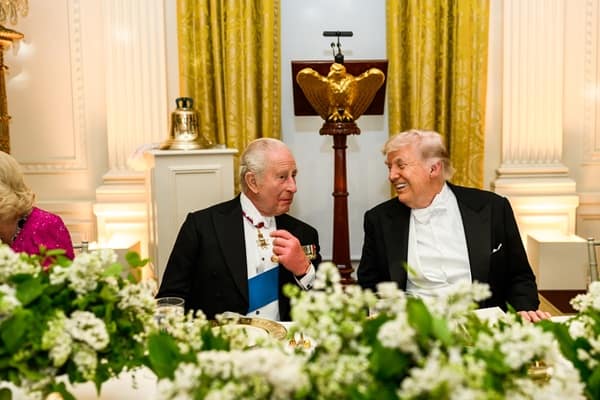
Britain’s sovereignty over the Falkland Islands appears to have been left undisturbed following King Charles’ state visit to the United States, after US officials moved to calm a diplomatic flare-up sparked by a leaked Pentagon memo.
The document, which prompted concern in London and Buenos Aires, reportedly suggested Washington could review aspects of its diplomatic posture towards allied nations and so-called “imperial possessions”, including reference to the Falkland Islands in a wider discussion of strategic leverage.
However, US Secretary of State Marco Rubio has dismissed the controversy, describing the reaction as “overexcited” and downplaying the significance of the material as little more than “just an email”.
Speaking after meetings linked to the King’s visit, Mr Rubio said: “It was just an email. People are getting overexcited by an email. It was just an email with some ideas.”
The comments were widely interpreted in London as an attempt to draw a line under speculation that Washington might shift its long-standing neutral position on sovereignty claims over the islands.
The Falklands have long been a point of contention between the United Kingdom and Argentina, and the leaked memo prompted renewed political pressure from Buenos Aires.
Argentine President Javier Milei reiterated his government’s claim, stating on social media that the islands – referred to in Argentina as the Malvinas – were “illegally occupied”.
His deputy, Vice President Victoria Villarruel, intensified the rhetoric, arguing that sovereignty should be discussed “between states” and dismissing the islanders as “English people living in Argentine territory”.
Argentina’s foreign minister also renewed calls for negotiations, framing Britain’s presence on the islands as a form of colonial legacy and urging bilateral talks.
Downing Street responded firmly, restating that sovereignty rests with the United Kingdom and emphasising the principle of self-determination. A spokesman said the islanders had “overwhelmingly voted” to remain a British Overseas Territory and that their wishes remained paramount.
For now, US policy appears unchanged. Mr Rubio confirmed that Washington maintains its long-standing position of neutrality on sovereignty, recognising the United Kingdom’s administration in practice while taking no formal position on ownership.
“Our position on the islands remains one of neutrality,” he said. “We acknowledge that there are conflicting claims of sovereignty between Argentina and the UK.”
The intervention came after discussions in Washington involving Foreign Secretary Yvette Cooper, amid wider efforts to steady relations following the diplomatic sensitivity generated by the leak.
The episode briefly revived scrutiny of one of Britain’s most enduring post-imperial disputes, particularly given Argentina’s increasingly assertive rhetoric under Mr Milei.
In 2013, islanders voted overwhelmingly to remain under British sovereignty in a referendum in which 99.8 per cent supported the status quo. Buenos Aires continues to reject the result as illegitimate.
Britain’s claim dates back centuries, with formal administration re-established in 1833 following earlier periods of contested control. The issue escalated dramatically in 1982, when Argentina invaded the islands, triggering a brief but bloody conflict that ended in British victory and the restoration of UK control.
That war left deep scars on all sides, with 255 British personnel, 649 Argentine personnel and three islanders killed during the 74-day conflict.
While the latest diplomatic flurry has subsided for now, the episode underlines how quickly the question of sovereignty over the South Atlantic territory can resurface in international politics — even if, as US officials now insist, the latest trigger amounted to little more than a poorly judged email.


Leave a Comment