
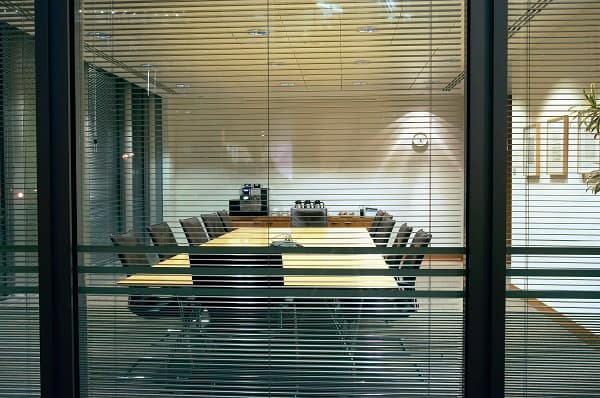
Start by putting it all on the table. (No pun intended.) Every company has defined values, even if they aren’t explicitly written down anywhere. Imagine assembling a roomful of 10-15 employees in a workshop and getting them talking about what matters most at work. Have a note-taker jot down the most repeated concepts. Those are your core values. Now, look at the top three. Are they represented in your C-suite meeting room or boardroom furniture?
Furniture is a values statement, whether you plan it or not
Every visitor who sits down in a conference room reads the space before the meeting starts. A heavy mahogany table with high-backed leather chairs tells a different story than a light oak surface with an open base and simple upholstered seating. Neither is wrong. But if a company markets itself as flat, fast-moving, and collaborative, and then seats its clients at a table built for a 1980s law firm, the mismatch is obvious to anyone paying attention.
This matters more than most procurement teams give it credit for. Employees notice it too. A workspace that visually contradicts the culture leadership talks about in all-hands meetings creates a quiet scepticism that’s hard to shake. Furniture decisions get made once and live with the company for a decade, so it’s worth treating them as part of the brand strategy rather than a facilities line item.
The old power table versus the modern collaborative table
The traditional executive table was built to project authority. Dark wood, oversized proportions, a head-of-table seat that made hierarchy physically obvious – this was furniture designed to communicate control. It worked for organisations that wanted to project stability and weight, and for some industries it still does.
But a lot of companies have moved away from that model, and their furniture hasn’t caught up. Modern conference spaces increasingly favour lighter materials, open bases, and shapes that don’t have an obvious “head” seat. This shift isn’t about trend-chasing. It’s a direct response to how companies want to be perceived: less hierarchical, more transparent, quicker to make decisions with input from the room rather than instructions from one end of it.
The psychology behind wood, steel, and glass
The choice of material communicates a message irrespective of whether anyone in the buying process is thinking about it specifically or not.
If you opt for Wood, you’re broadcasting tradition, warmth, and permanence. It’s the go-to material for legacy organisations – law firms, financial services, family-run businesses. If you go with Steel, it’s precision and longevity you’re putting out into the world. Powder-coated steel bases, in particular, read as engineered and built to last. This is what you want if you’re out to project operational rigor. Glass indicates openness, clarity, and forward momentum. It’s the modern, unguarded choice.
Mixed-material designs (e.g., glass surface on steel base = openness meets structural confidence) allow you to balance two messages. None of this is accidental. Designers have known about material psychology for decades now. The error companies tend to make is that they base their purchasing decision on price and availability rather than on the message the piece is actually sending.
Why glass conference tables specifically reinforce transparency
Glass offers a unique feature that no other material provides: it eliminates visual obstructions between participants. Each person sitting at the table has a direct line of vision to every other person present, and there is no major structure forming a mental barrier between one side of the room and the other. For organisations that emphasise flat organisation systems, open dialogue, and decisions that involve the entire room full of stakeholders, this is not only good to look at but a genuinely functional surface for the culture they are trying to build.
A glass conference table also does one more thing. It makes the statement that the company doesn’t have anything to hide. In lines of work where trust and transparency matter to clients (consulting, finance, tech, professional services, etc.), meeting across a see-through surface as against a solid, opaque one can subtly alter the feel of the room right from the word go. For better or worse, first impressions and assumptions come to play in any meeting setting. A glass top leaves you with nowhere to hide.
Eye contact could be more direct. The feel of the room could be more open and accessible. If your company wants to underpin its decision-making process on democratic principles, that isn’t a minor detail to consider. Then there are the more mundane benefits: glass-topped tables make a room appear larger, and in a conference space that is deprived of natural light in the first place, every bit of a light, reflecting surface helps. Also, they photograph well, which is a less esoteric thing to say if the boardroom table makes an appearance on your company website.
Sustainability as a values driver, not a marketing line
If a company is discussing environmental responsibility in any of its public communications, its furniture needs to reflect that. This could be the easiest place for a values disconnect to emerge, because furniture sourcing is never questioned in the same way other decisions about the supply chain are.
FSC-certified woods, recycled glass content, and low-VOC finishes are all now widely available and not meaningfully harder to source than uncertified alternatives. These details are increasingly remembered by employees and clients, and procurement teams that simply ask these questions on the front end don’t face the uncomfortable gap between their values and their purchase history. Besides, the World Green Building Council’s frequently cited research on indoor environmental quality suggests that improvements in lighting, air quality, and layout can improve workplace productivity by as much as 13%. That’s a helpful hint that furniture and spatial decisions aren’t merely decorative: they influence outcomes we can track, not just vague impressions.
Practical feasibility: what actually holds up
Values-driven design is only as good as the quality of the product itself. A scratched glass tabletop or a wobbly base under normal use will send the wrong message and potentially undo all the good intentions that went into material selection.
Here are some things to keep in mind when evaluating a conference table – glass or otherwise – as a viable purchase:
Glass thickness and treatment. Tempered glass is the standard for conference tabletops because it is vastly more impact-resistant than laminate alternatives, plus if it does reach failure, it breaks into small, less dangerous pieces. Anything under half an inch thick in a large table is worth questioning.
Tint and finish options. Clear glass maximises the openness effect, but tinted or frosted variations can reduce glare and soften reflections in rooms with heavy overhead lighting, without losing the transparency message entirely.
Base construction. Powder-coated steel will not chip, flake, or corrode nearly as quickly as a painted alternative, and it holds up under the kind of daily contact – knees, laptops, rolling chairs – that conference tables absorb over years of use.
Scale relative to the room. A table that’s too large limits walk room, forces clutter, and makes a room feel small and cramped. A table that’s too small, especially in a larger room, can feel inconsequential and thrown in. Table shape – and consequently size – should be determined by the way the room functions and its geometry, not the other way around.
Thinking about total cost of ownership, not sticker price
Throughout its lifetime, an executive table will be used in thousands of meetings. The number of times it is used makes the cost of purchase almost insignificant when compared to the quality, the guarantee offered, and how easy it is to adapt the item with an expanding or relocating business.
A cheaper table may need to be replaced after only four years and over a ten-year period will end up costing more than a fit-for-purpose table that can last fifteen years. The length of a guarantee is a good indicator of how confident a manufacturer is in the quality of its product. A good warranty and a modular table for resizing, splitting, or reconfiguring will help ensure the business will outgrow the meeting room design long before the table.
Building a cohesive room, not just picking a table
The table is important, but other elements are essential too. Lighting is critical because the colour and brightness of lighting can affect how we perceive conference room design materials. For example: wood can look drab and faded under cool white light; maple can become a dull yellow, and cherry wood looks vaguely grey. Similarly, different types of glass – like ultra-clear low-iron glass compared to standard grey glass – respond differently to warm and cool light. Warm amber light can make glass or other cool materials feel cooler than you might have liked them to appear.
Seating needs to match the formality level the table is projecting; putting stiff executive chairs around a casual, light-toned table sends mixed signals just as easily as the reverse. Acoustic treatment matters more than most buying teams consider. Hard surfaces like glass and steel can make a room echo, especially in spaces without carpet or acoustic panels. A conference room that looks striking but makes conversation difficult to follow undercuts the very communication culture the design was meant to support.
Designing for hybrid meetings
Most meeting space today has to be hybrid-ready in some way. And that shift has consequences. Tables need to integrate power and data ports so that remote attendees don’t trip over extension cords while the people in the room don’t worry about their laptops running out of battery. Cameras need to be factored in as well. A long conference table that clusters all participants at one end means that remote attendees will get a good view of a wall or ceiling rather than the people they’re talking to. And cameras or screens at the edges can be intrusive if there’s no space between participants and the technology.
None of this is separate from the values conversation. A hybrid-friendly room signals inclusion for remote employees the same way an open table shape signals inclusion for everyone physically present.
The table tells the story before the meeting starts
Selecting furniture for a conference room won’t save you if things go wrong culturally within your firm (and we all know much of the time they will), but it can help you have stronger, more honest conversations about what you aspire to be, by making that aspiration a little more tangible. Be sure the furniture in that room reflects what your company values most.


Leave a Comment