
In recent days, the global gold market has experienced heightened volatility driven by political and economic events in the United States, particularly the ongoing government shutdown, which has begun to erode investor confidence in the American economy visibly.
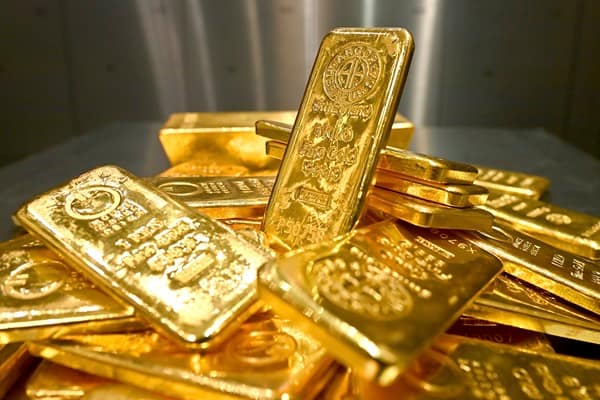
Gold prices surged past $3,950 per ounce during early European trading on Wednesday, reflecting growing market anxiety and a renewed appetite for safe-haven assets amid escalating risks and uncertainty.
In my view, this rise is not merely a corrective move but a clear signal that global markets are already pricing in the likelihood of a broader economic slowdown or even financial disruption if the shutdown persists.
The U.S. government shutdown, now entering its sixth week, is no longer a domestic political standoff—it has evolved into an international economic pressure point threatening market stability.
Concerns are mounting over its impact on government spending, consumer confidence, and ultimately global growth. Historically, government shutdowns in Washington have been seen as opportunities for risk reassessment, but this time the extended duration and deep partisan divide over budget negotiations are pushing investors to adopt more defensive positions, led by hedging through gold.
From my perspective, this trend is likely to continue as long as uncertainty dominates the U.S. political scene, especially if Congress fails once again to pass a temporary funding agreement to reopen federal institutions.
Despite this impressive recovery, gold still faces significant headwinds. As a non-yielding asset, it tends to be pressured by a stronger U.S. dollar and higher real bond yields—two factors currently weighing on short-term price momentum. We have already seen how a rising dollar and fading expectations of Federal Reserve rate cuts have limited gold’s ability to sustain levels above $4,000. Traders have become less convinced that the Fed will deliver further monetary easing this year, especially after Jerome Powell’s clear message that additional rate cuts are “not a given.” In my opinion, this marks a turning point in market sentiment, signalling that U.S. monetary policy is likely to remain relatively tight in the near term—creating a temporary ceiling for gold’s advance.
Nevertheless, the delicate balance between dollar strength and shutdown-induced fears creates a volatile and uncertain environment, turning gold into a battleground for opposing forces. Should the shutdown persist and U.S. economic indicators continue to soften, we could see a renewed shift in rate expectations, reigniting upward momentum for the yellow metal. I personally expect that the upcoming ADP employment and ISM services data will be decisive in shaping gold’s short-term direction. Any weakness in these reports would likely be interpreted as further evidence of a slowing economy, potentially forcing the Fed to adopt a less hawkish stance—thereby offering renewed support to gold prices.
On the geopolitical front, the situation remains equally complex. The ongoing tensions between the United States and China—despite some signs of tariff de-escalation—continue to cast a shadow over investor sentiment. Beijing’s decision to raise tariffs on U.S. agricultural goods even as Washington cuts certain import tariffs on Chinese products reflects a fragile balancing act that does little to dispel uncertainty. I believe these developments are fuelling increased demand for gold not only as a hedge against political risk but also as a store of value amid currency volatility and shifting global trade dynamics.
While some investors view the current gold rally as an opportunity for profit-taking, I maintain that the medium-term trend remains bullish. Several factors underpin this outlook: the ongoing U.S. government shutdown, declining consumer confidence, and evidence of an economic slowdown in China—highlighted by a drop in the manufacturing PMI to 50.6, below expectations. Collectively, these signals are dampening global risk appetite and boosting demand for defensive assets. From this standpoint, I see any near-term pullbacks in gold as temporary corrections rather than the beginning of a sustained downtrend.
Technically, maintaining support near $3,920 per ounce is a positive indication that upward momentum remains intact, while a breakout above $3,980 would open the door toward $4,050, a level that could be tested soon if political paralysis in Washington continues. However, traders should remain cautious of sudden moves in the dollar or bond yields, as short-term profit-taking could trigger brief retracements.
In conclusion, gold currently stands at a delicate equilibrium between two opposing forces: on one side, the U.S. government shutdown and geopolitical tensions that enhance its safe-haven appeal; and on the other, the strong dollar and the Fed’s cautious monetary stance, which cap its upward potential. In my opinion, unless a swift political resolution is reached in Washington, the medium-term trend will remain bullish, with gold potentially surpassing the $4,100 mark in the coming weeks. Ultimately, gold continues to serve as the world’s mirror of uncertainty—the timeless refuge investors turn to when visibility fades and volatility takes centre stage.


Leave a Comment